Buzzing (Nomenklatura) Doubts. On the exhibition ‘Antanas Sutkus. The Sweet Life (of the Nomenklatura)’ at the House of Histories
Apie parodą „Antanas Sutkus. Saldus (nomenklatūros) gyvenimas“ Istorijų namuose
I would like to ease the reader gently into this text, to begin the narrative with a city wrapped in dampness, and then, almost imperceptibly – like nuts embedded in a cake – to lay out the drier facts, hiding the main structural framework beneath a layer of glaze, even if it is less attractive than festive fireworks. But that will not work here, because it is important from the outset to explain how this text (and perhaps others to come) differs from what I have written before. I will begin with a somewhat metallic framework, tightened with newly gleaming bolts.
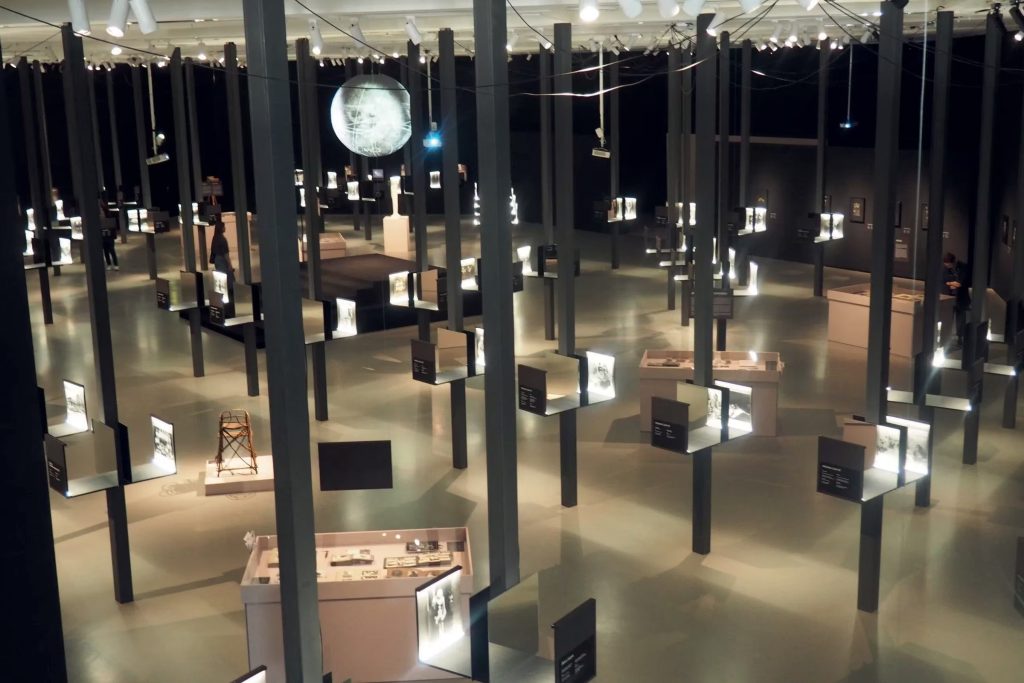
Laima Kreivytė’s doctoral dissertation KURuoTI (CUR(e)ATE/ C(u)REATE): Curating as Artistic Practice and Politics establishes curating as an artistic practice. Within this framework, the exhibition itself becomes an artwork. As we know, it consists not only of the artefacts on display. I will say nothing new by stating that everything hinges on the (curator’s or artist’s) concept that forms the axis of the exhibition. Yet such an artwork (the exhibition) also has its own plastic expression. Its visual body is composed of the works by the artist(s), the space, architecture, frames, even labels containing texts – whose language, precision and graphic design sometimes occupy a substantial part of the overall concept. When thinking about exhibitions as coherent (or not) artworks, museum projects often come to mind first – those supported by substantial1 (or modest) funding, involving large teams and well-paid architects. However, it is hardly news that impressive, conceptually coherent exhibitions are also frequently produced by artists themselves, sometimes with no funding at all or only minimal resources. One such example was Laima Oržekauskienė-Ore’s Textile Essays, where even the height at which objects were hung or the labelling was carefully considered. Everything functioned, breathed, spoke.
Within the field of art, alongside official criticism, there circulates a parallel form of critique that may be even more important: composed of colleagues’ opinions, casually dropped words of admiration or dissatisfaction, questions such as ‘have you seen it?’. For some time now, the question ‘have you been to the Sutkus exhibition?’ has been hovering in the background, and so the first exhibition I would like to consider as a coherent artwork is curator Thomas Schirmböck’s Antanas Sutkus: The Sweet Life (of the Nomenklatura). We can more or less imagine the photographs of the famous photographer, although the theme of the nomenklatura is still relatively new, insufficiently researched and deserving of attention; yet it seems there should be no hidden reefs here. And yet, how often a smooth water surface conceals aggressive obstacles capable of sinking even the Titanic! True, this exhibition is not in the Titanic (exhibition halls Titanikas), but in the House of Histories of the Lithuanian National Museum.
On entering, the viewer is met by a narrow passage – greenish painted exhibition partitions transformed into a corridor, separated from the main hall. Photographs hang along the corridor walls. The exhibition architecture is, in principle, successful (architects Jurgis Dagelis, Justinas Dūdėnas): the green space is dedicated to photographs of a ‘common man’, or, as it was known in the Soviet times, ‘the people’, and is titled ‘Everyday Life’. Turning the corner, one enters the main section, painted coral pink, dedicated to the nomenklatura. However, in the green corridor, black-and-white photographs are framed in unpainted wooden frames (a curatorial or architectural decision?), which today tend to be associated more with style and luxury. Meanwhile, the colour photographs in the ‘people’s’ corridor are presented on aluminium composite panels without frames, which bears no association with the Soviet period whatsoever. There are no labels, only general texts on old furniture boards and photograph numbers, so the viewer may choose between two strategies – simply looking at the images and Sutkus’ photographic mastery without paying attention to the names, events or locations depicted, or carefully reading the information booklet. The descriptions are not short, so a serious viewing of this exhibition would require at least a couple of hours.
However, as soon as one begins to read the texts, doubts gradually creep in. One by one they buzz like mosquitoes that have found their way into a room, eventually turning into a swarm of large, persistent hornets. At first, one notices that even approximate dates are not provided next to the photographs. For an exhibition claiming to reveal a historical period, the dates of creation seem to me no less important than the individuals depicted. Dates are part of the metric data of Sutkus’ works, and their absence suggests an attitude towards the photographer and his images as anonymised ‘material’ for his vision. Some shots may indeed have lost their birth dates over the course of a long life, but museum practice provides ways of indicating approximate dates.
The second surprising curatorial strategy employed by Schirmböck is that the texts accompanying the photographs in many cases meticulously list everything visible in the frame: ‘A solitary worker is working on the roof of a building, behind which two tall chimneys release smoke into the air.’ Or a photograph titled ‘Under the Signboards’: ‘A man on a bench reads a newspaper in the sun, while a woman sitting next to him looks down. Behind them hang five propaganda posters in Russian, which do not attract their attention.’ Do we need to point out that the posters are behind the seated figures, so the two naturally cannot be looking at them? The question of why it is necessary to describe what we can already see remains open, especially as there are stranger descriptions still – for instance, a photograph of three people titled ‘Troika’. Perhaps the younger generation does not know the terror once associated with this word. Retaining its Russian form in a Lithuanian text indicates that this is, as it were, a term that from the 1930s referred to a three-person NKVD extrajudicial punitive body authorised to sentence people to death without trial or appeal; a denunciatory note from an anonymous informant could suffice, and ‘troikas’ were intended to eliminate those obstructing Stalin’s regime. Another meaning of ‘troika’ is three horses harnessed to a carriage. Is that what is meant here? The answer remains off-frame, making it difficult to understand why three people in a photograph are labelled ‘troika’ without explanation – why was the Lithuanian word trijulė insufficient? And if they did not collaborate with the NKVD, does such a title not verge on slander?
The photograph ‘Lazdynai, pavement’ is again described by narrating what the viewer already sees: ‘A well-known photograph by Sutkus depicting two young women in a suit and a raincoat, swinging their handbags and balancing on the edge of a pavement leading towards newly built apartment blocks. The women’s lightness in such circumstances symbolises a certain trust and hope.’ There is no explanation of why the construction and architecture of Lazdynai were significant at the time, no discussion of the possibility for young people to obtain an apartment in the Soviet period, nor any other historical context. The same applies to the photograph ‘At a Party’, described more tersely: ‘Playwright Gražina Mareckaitė and art historian Ingrida Korsakaitė at a party.’ There is neither a date nor any indication of why two prominent cultural figures appear among the ‘working people’…
No, I do not wish to suggest that these intellectuals were part of the nomenklatura – but neither was the poet Paulius Širvys, whose photograph nevertheless appears in the nomenklatura section, hanging on coral-coloured walls near images of Lionginas Šepetys, Ringaudas Songaila and others. The accompanying text does not explain his inclusion either: ‘Poet Paulius Širvys, of a difficult fate – an orphan, a cowherd in childhood, wounded during the Second World War, later a journalist, studied literature in Moscow. In his early work he expressed socialist realist tendencies, later his poetry acquired a more romantic tone. In 1967 Širvys began working as a fisherman in Klaipėda.’ In the section texts mounted on furniture boards (an enjoyable architectural solution), the curator defines nomenklatura as follows: ‘Soviet nomenklatura may be defined as individuals occupying leading positions in the Party and Soviet administrative institutions, which enabled them to improve their living conditions.’ Širvys was not a functionary and ultimately worked as an ordinary fisherman; being a war veteran does not make one part of the nomenklatura.
The photograph descriptions are, in fact, rife with factual errors. For example: ‘Isn’t this photograph somewhat amusing? He sits in front of three telephones and a luxurious internal communication system and does not know what to do. We do not know on what occasion this photograph was taken, but that does not matter, because we can speculate about what troubles him. Perhaps it is the dark telephone – it seems its light is on: an unpleasant call is expected?’ The most amusing thing here is not the photograph – we see three rotary-dial telephones, which have no lights whatsoever (or, at least, used to), only a paper strip below for writing a number, which the curator apparently mistook for a light. Not to mention that it is entirely unclear who ‘he’ is.
Another example is the ‘Persian’ hat in Ringaudas Songaila’s photograph: ‘Songaila has already removed his Persian hat and, having taken off his gloves, is leafing through the latest issue of Tiesa, or at least pretending to do so. Songaila was an apparatchik who played a central role in the destruction of rural culture in Lithuania in the 1960s. He made a career in the party but was dismissed in 1988.’ That ‘Persian’ hat is in fact a karakul military-style hat; I have never heard of the term ‘Persian’ used for such headwear in Soviet times. Perhaps I simply did not take an interest in such matters then, but the Russian word apparatchik, presented without quotation marks, once again raises questions, like ‘troika’. Although it refers to Soviet jargon, it should perhaps be placed in quotation marks and explained. It would also have been worth noting why Songaila was dismissed, given that in 1988 the authorities already felt the breath of Sąjūdis on their backs – the movement having emerged that same year.
At the end of the section devoted to ‘common people’, we encounter a still life composed of a chipped teapot, decayed faience plates from the ZIK factory, a horribly dusty and aged VEF (State Electrotechnical Factory) radio receiver, a children’s plastic ‘Gabriela’ sewing machine, a kitchen appliance that looks suspiciously new, rubber boots and various other storeroom debris. Such images cast doubt on the curator’s competence altogether. Anyone, even without being a historian, will say that people did not eat from broken crockery, that while these objects may not all have been high quality, they were at least new; and that the children’s sewing machine was produced by the GDR factory ‘Piko’, meaning such toys in Lithuania would most likely have reached only the children of nomenklatura members. Clearly, when selecting exhibits for an exhibition, one could at least conduct minimal research – household objects also have designers, and even an unattractive little dish can possess historical value. In truth, if we leave today’s paper packaging for flour, sugar or eco-friendly laundry detergents of muted design in a storeroom for five years, we will obtain a similar image. Hence, this little rubbish heap, intended to illustrate the curator’s vision of life at the time, drifts far from basic factual reality.
I will not further exhaust you with details that wore me down to the extent that I hurried past the section devoted to hunting (many, many very similar photographs of darkly dressed men against snow) and an unnamed installation featuring a deer’s head, with enormous antlers, studded with knives. One might argue that the section devoted to telephone conversations is genuinely interesting – the photographs are expressive and varied, and the whole is compelling – as are ‘Parades and Other Public Celebrations’. However, throughout the exhibition there are simply too many photographs; they interfere with one another, are printed in small formats, further diminishing their impact, and include some unsuccessful shots. Most troubling, however, as I have said, are the descriptions. Even ignoring the inaccuracies already mentioned, some names are left unexplained (for instance, wondering why singer Giedrė Kaukaitė appears among the nomenklatura, I had to look up the biography of Juozas Maniušis, seated next to her, online – it turns out he was a major Party figure, yet this is not mentioned in the text). Finally, I do not understand why some Lithuanian exhibition makers maintain the assumption that the viewer is dumb and uneducated and that everything must be explained as to a three-year-old. In Antanas Sutkus. The Sweet Life (of the Nomenklatura), not only is the viewer told what is already visible in the photograph, but the curator’s interpretation is presented as objective truth. For example: ‘A group of young women marches dressed in identical violet summer dresses. They hold red scarves in their hands, which they are supposed to wave enthusiastically on command. One woman hides her face behind her red scarf – this may be considered a perfect symbol of individual power.’ The woman is most likely wiping her face with the scarf, but interpretations can certainly vary – and the curator should not insist so forcefully on his own version.
So, having skimmed past the marching women and Party officials delivering speeches, I left the exhibition unfinished, with the theoretical possibility of returning. But is it worth it? As mentioned, the architects’ concept is interesting and aligned with the exhibition’s idea, but it is not enough – not even Sutkus’ photography can save it. His images undeniably possess artistic and documentary value, yet presented without dates, with factual errors in the descriptions and problematic exhibition practices, that documentary value is significantly diminished. It is particularly disheartening that the curator seems not to care much for Sutkus’ photography itself; otherwise, it is unlikely that some poorly cropped images – of the sort abundant in any photographer’s archive and not necessarily meant for display – would be shown publicly. The photographs also suffer from a crammed installation. I would say that very little separates this exhibition from becoming a vivid, compelling project on an important theme with distinctive architecture – chiefly, curatorial competence. Then again, why conduct serious research or exert oneself when one can simply describe what is visible in the photographs? Especially if one operates under the assumption that the Lithuanian viewer possesses the intellect of a preschooler.
Until May 11 2025, House of Stories (T. Kosciuškos St. 3, Vilnius)