From They towards We. Virgilijus Šonta’s exhibition ‘School Is My Home’ at the Photography Museum
Virgilijaus Šontos paroda „Mokykla – mano namai“ Fotografijos muziejuje
In the photograph placed at the beginning of the exhibition School Is My Home, I see a young man looking straight into the camera – Virgilijus Šonta, standing beside a building whose window-frame paint is already flaking badly. He is surrounded by children leaning out of the windows and by others standing a little further away outside, behind him. Šonta photographed life in special boarding schools in Šiauliai and Kaunas, and the children living there, over the course of three years. So it is almost possible to say that, at that time, these institutions had become a kind of home not only for the children but also for the photographer himself. After all, home is not only a physical, fixed space with walls and a roof, but also a (temporary) sense of sameness and belonging.
Still, the true inhabitants of these homes are the children with special needs photographed by Šonta. Looking at the images, I can sense that for many of them these boarding schools had long since become their homes. These schools were not meant only for attending lessons and education. The children, like one large family, wake up together, wash, eat, sit at desks in the classrooms, eat again, play or do sports together, and after what was probably a modest dinner, get ready for bed together and begin the same cycle anew the next day. Adults are barely visible in the photographs, and when they do appear, they are teachers or boarding school supervisors with specific roles and duties. One can only speculate about the parents of the residents. The spaces captured by Šonta are not merely children’s homes; they constitute the children’s entire world, governed by its own rules and traditions and, as the photographs suggest, by hierarchies dictated by age.
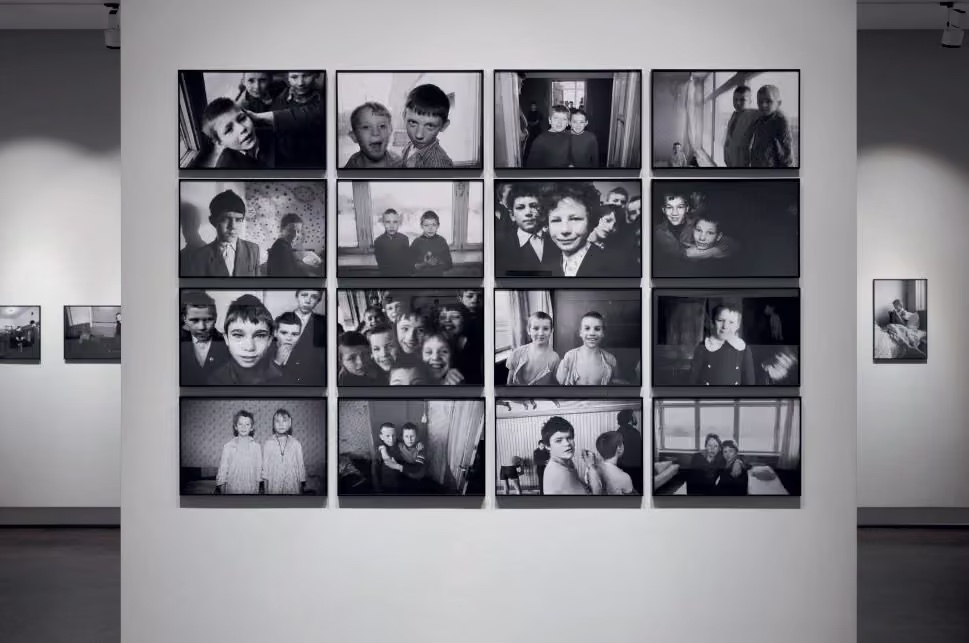
The exhibition display structure is simple. The walls of the gallery are hung with a dense sequence of works, and one side of a wall standing in the middle of the space is covered with close-up portraits of children looking directly at the viewer. At first, this structure struck me as overly simplified, yet once the impressions settled I came to see it as a strong choice, effectively conveying the childlike energy of life in these schools, but also its monotonous, circular rhythm. More elaborate or experimental exhibition design solutions would not have matched the childlike yet externally isolated routine conveyed by the photographs and would have created dissonance. The curator Valentyn Odnoviun’s decision to exhibit the photographs without retouching also seems right. Cracks, scratches, and traces of dust visible on their surfaces highlight the materiality and authenticity of the images.
In the photographs, the presence of the author within the same physical space is barely felt. The children play, eat, study, run about, or even fight ‘undisturbed’, as if no adult with a camera were standing nearby. For a moment, this strangely creates the impression that some of the images might have been obtained from surveillance cameras placed around the boarding school grounds, anonymously and distantly observing and recording the children’s lives. Šonta managed to blend into this childowned reality unnoticed, capturing the atmosphere without creating a barrier between I and they. This is entirely opposite to what Soviet ideology sought to impose, and what, as the philosopher Michel Foucault described, earlier epochs also aimed to establish. Those who did not conform to the norms were punished through isolation and separation, forming an ostensibly sterile, healthy, disciplined, and uniform environment and society. Through these photographs, Šonta makes an invisible social realm visible, thereby granting it presence. His resistance to the regime resulted in the fact that, in 1983, he never received the prize awarded by the jury of an exhibition in Šiauliai for this series, after intervention by Moscow censors. As stated in the exhibition text, this historical injustice is now being symbolically redressed.
I try to imagine what it meant for a child with special needs to grow up in a boarding school at the end of the socalled stagnation era, when it was believed that the Soviet system would never end, but I find it difficult. Šonta’s series School Is My Home offers a chance to glimpse this reality and shows that, despite internal and external hardships, childhood is a force stronger than developmental disorders or ideological regimes. One photograph in the exhibition depicts a teenager in a school uniform leaping from swings set in vigorous motion, forming a star shape in the air with their limbs. This jump, even if only briefly, for a single moment, conveys a sense of freedom, vitality, and independence, usually crushed by the weight of reality. The connotations of the communist star are displaced here and replaced by the playfulness of childhood. In this way, Šonta’s series functions like a crack that opens up what the regime had attempted to conceal behind the drawn curtain of its time.
Until May 11 2025, Museum of Photography (Vilniaus St. 140, Šiauliai)