Niépce’s Signature. Photographers’ Meetings in Nida 2025
Fotografų susitikimai Nidoje 2025
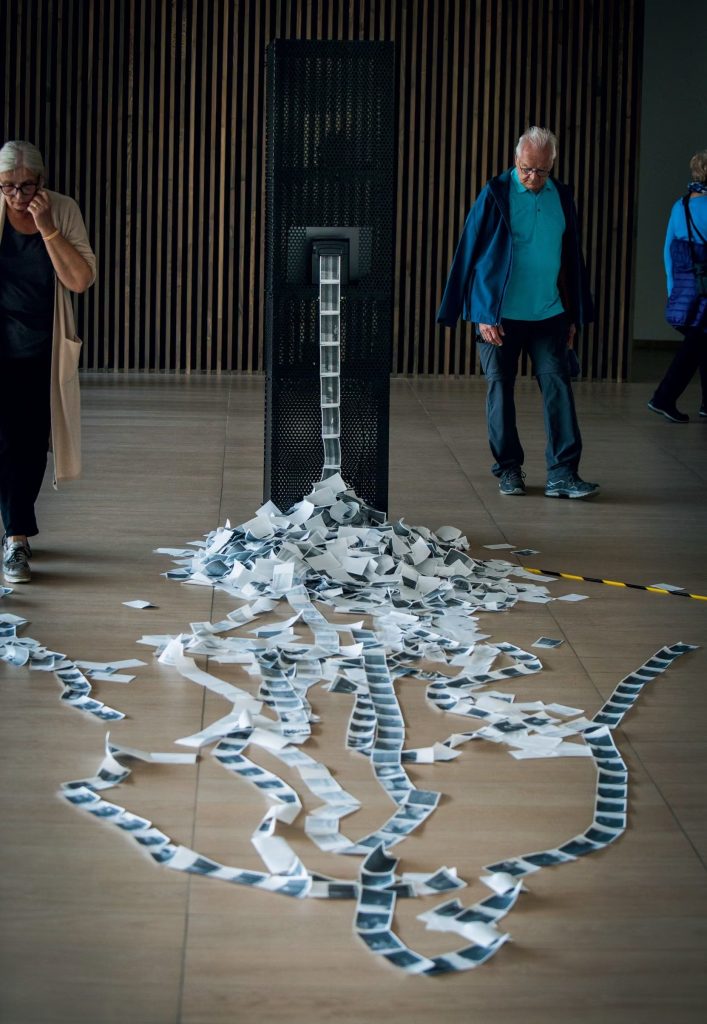
From the photography symposium in Nida I brought back several books and three souvenirs. The first is a faint, printer-spat photograph on receipt paper. It shows me standing against the wall of the new ‘Agila’ cultural centre. The image is so pale that hardly anyone will recognise me. I barely recognise myself either, though I know it’s me. To be honest, in order to take it – somewhat illicitly – I lingered twice in front of the camera. The aim of Paulius Rukas’ installation In situ was to bear material witness to the presence of each of us, instantly transformed into a pile of visual waste. My image will disappear as well, since the function of this medium is not to preserve insignificant records for long.
The other two souvenirs seemed to slip into my pocket almost by themselves – as they do every year. I cannot resist tasting the teas brought back from the Far East by Ieva Rutė and poured into cups she has shaped herself. We drink, chat about this and that, others join us, eyes widening after a sip. When the thermos runs dry, Ieva pours the tea leaves onto photographic paper, allows traces to be left, then cuts the sheet into as many pieces as there were ‘drinkers’ and hands them out so that everyone can carry a fragment back into their own worlds, where the image will fade over time. On my scraps of photographic paper two tea-drinking situations are temporarily inscribed. The first – a sixty-year-old tea from Taiwan, drunk on the evening of 17 September. ‘A tea we drank at night with wine, discussing the colonial history of the Polish-Lithuanian Commonwealth and Lithuanian national feelings with Adam, Narkevičius, Narušytė and Co. And it all began in Kaunas.’ The next morning, together with two French women – curator Sonia and photographer Isabelle – we drank the socalled PhD tea. After tasting it, Sonia rushed off to write an article, while we headed to the lectures.
Those three souvenirs symbolise for me the experience of this photography symposium, in which the flow of images and narratives is at times dammed by politics, yet every day recoloured by the people encountered.
Intersections of Photography and Politics
Russia’s war against Ukraine compels us to notice signs of political position everywhere – or their absence. Sonia Voss speaks about the East German photographer Sibylle Bergemann, who documented the construction of the Marx and Engels monument in Berlin between 1977 and 1986. One immediately asks oneself: do the photographs convey the approval of the authorities, or are they neutral? Sonia attempts to reveal their critical dimension – and indeed, in Bergemann’s images the two thinkers who underpinned socialism look like monsters. Yet the censors failed to grasp the photographer’s mockery. On the other hand, Laima Kreivytė, analysing the exhibition Between Two Dawns at the National Gallery of Art, noted a lack of political awareness – or at least of artistic activism – in an image that has already become iconic and was acquired by the Lithuanian National Museum of Art: the photograph of Rūta Meilutytė swimming through a pond dyed red in front of the Russian embassy.
Although the symposium programme did not include lectures on war photography, one evening featured the screening of the film Focus on Infinity (dir. Ksenia Kravtsova, 2023) about Ukrainian photographer Oleksandr Glyadyelov, for whom ‘photographs became a weapon’ in bearing witness to the brutality of Russia’s war. In this context, many were unsettled by the film Babochka – more precisely, Бабочка – presented by the British filmmakers Laurie Griffiths and Jonty Tacon. As Britain was preparing for the Brexit referendum, they travelled to Visaginas and began photographing the landscape and its inhabitants. They returned during the full-scale invasion to make a film about a town where a nuclear power plant is being dismantled, as this had been a condition of Lithuania’s accession to the European Union, as the film’s subtitles state. For local residents, of course, it is painful to dismantle what their parents built. It is also hard to lose an employer when nothing replaces it. ‘There was no other plan,’ the artists claim, ‘it was hoped that those people would move away.’ Yet many stayed regardless. In the film this is interpreted using the anthropological term endurance. The filmmakers’ empathy for people left without their dream is understandable, but anger rose in the audience and erupted in the question: what about the occupation? Was there none? The British had not even considered it. For them, the forced construction of a nuclear power plant in one of Lithuania’s most beautiful places, and the relocation of large numbers of Russian-speaking workers, did not seem like a problem requiring reflection. They see only a modernist utopia that collapsed when we chose independence. In the context of war, one is tempted to see Kremlin propaganda here, yet conversations after the presentation made it possible to persuade them to be more attentive to local context next time.
Should these British filmmakers have been invited to speak about a film with a Russian title? Yes – because it was an opportunity to acknowledge our own state’s failures in avoiding the inclusion of Visaginas residents in nation-building. It was also necessary to sense the peculiar position of some Westerners and attempt to explain our own. It is only regrettable that the Brits left the next morning – they might otherwise have seen the lifelong documentation by brothers Algimantas and Mindaugas Černiauskas of a Lithuanian landscape distorted by Soviet occupation and the people living in it – impoverished yet smiling. It makes me wonder how their film might have changed had they heard the story of a woman who found her husband, a partisan murdered by stribai, laid out in the square of Molėtai. And perhaps in the faces of Siberian deportees photographed by Tadas Kazakevičius they would finally have seen the suffering caused by the loss of homeland and the deaths of loved ones – suffering that would no longer allow the forced deportation of more than a hundred thousand people to be compared with voluntary ‘mixing of nations’.
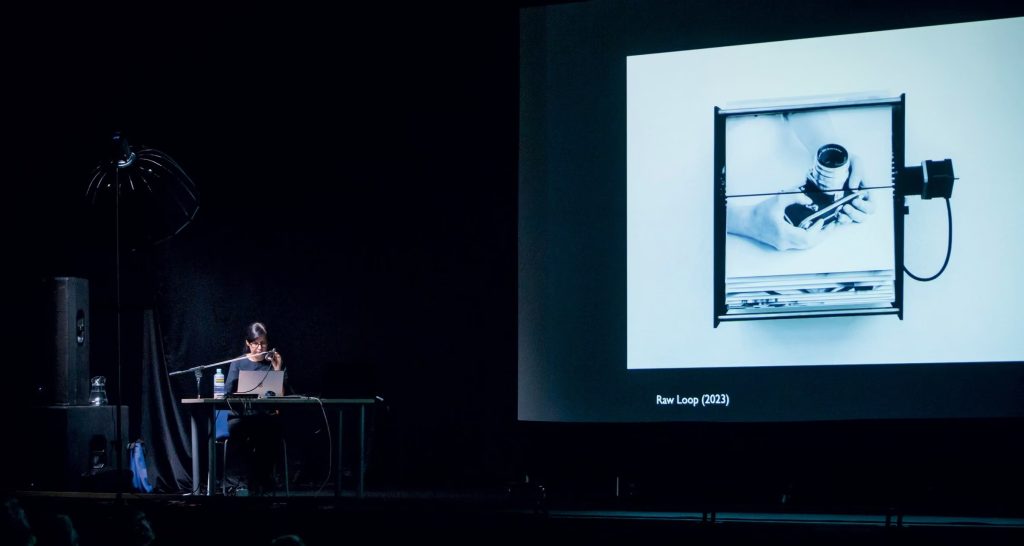
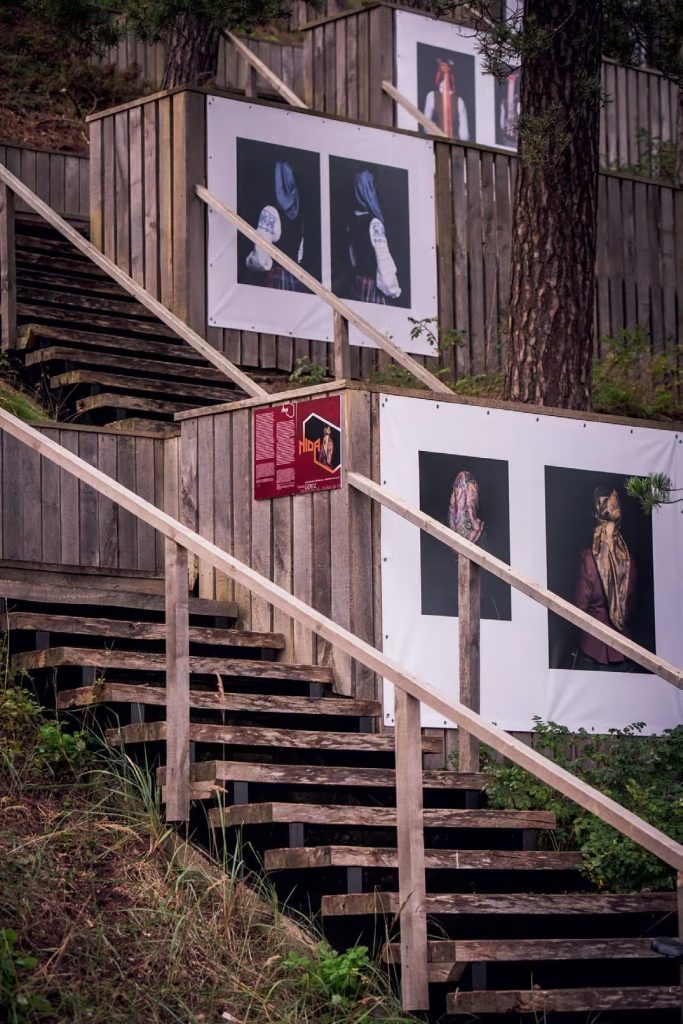
But if they had listened, would they have wanted to understand? This thought arose while listening to Aušra Griškonytė-Volungė’s presentation. For nearly two decades she has been photographing portraits of the queer community – people of fluid gender identity dressed in women’s clothing, as ‘Whores’, adorned with veils as ‘Brides’. It seems a turning point has occurred – these works are now shown in prestigious exhibition spaces and no longer shock. Yet in the artist’s text the words kept recurring: exhibition closed, photographs taken down. She herself continues to be harassed and threatened. Discrimination in Lithuania remains widespread. For this reason, Volungė created the series The Invisible (2024) – the portrayed figures are barely visible in the darkness. In exhibitions viewers pass by without even realising that something is there. This is symbolic – we still do not want to see vulnerable people, so why are we surprised when foreigners do not want to see our occupation?
We do not even notice when invisible people leave – sometimes in search of a better life, sometimes fleeing persecution. They leave – and it becomes possible not to think about them anymore. Several lectures and presentations this year addressed the desire of emigrants to return, even when it is dangerous. An example from the nineteenth century is Eustachy Poklewski-Koziełł, whose life was reconstructed by Dainius Junevičius – who among other things explored French archives. The young Eustachy took part in the 1863 uprising and was deported to Siberia, but escaped and ended up in Paris, where he became secretary of the French Photographic Society. In Paris he promoted and presented photographers from the Russian Empire, among them the Vilnius-born Józef Czechowicz. Yet he missed his homeland so deeply that he returned once repression had eased. Contemporary photographer Mykolas Juodelė and graphic designer Sandra Rivero spoke about Sandra’s great-grandparents, who together with thirty thousand other Lithuanians sailed to South America during the interwar period. Fulfilling her ancestors’ dream of returning to Lithuania, Sandra brought back the story of José Šlapelis, the first photographer of the town of Sarmiento founded by the Kupiškis-born Šlapeliai.
Landscapes as the World Collapses
War has pushed climate change into the background, but the threat has only grown. At the symposium we saw a now familiar series of photographic reflections on humanity’s relationship with nature. Adomas Žudys playfully – or perhaps deliberately absurdly – links the excavation of the roots of an ancient oak to conspiracy theories that distract us from solving the problem. A very different mood emerges when listening to the Swede Mercé Torres Ràfols, whose poetic images seem to condense geological processes and human histories into a time where rocks burst from spiritual energy. Even Kristyna Müller, who was meant merely to present the activities of The Center for Photography in Sweden, spoke mostly about the topic that concerns artists most – the landscape, symbolising humanity’s ultimate defeat as mountains tremble under resource extraction.
In this context, Artūras Raila’s project Power of the Earth. Mythological Vilnius (2005–2008) becomes newly relevant. One may disbelieve the energy lines drawn by dowsers, yet the photographed landscapes are dense with meanings that are only intuited as a secret text of nature. The title of Erika Grigoravičienė’s lecture, ‘What Is Left After the Essence Has Departed’, borrowed from Olivia Laing’s essay on Andy Warhol’s time capsules, resonated with particular precision. When the essence leaves objects, they lie useless, yet do not die – they continue an uncared-for existence until eventually merging with nature and feeding it. Such are Alvydas Lukys’ photographs of food waste destined for compost, and the cardboard box left in his yard – changing shape, drawing ever closer to the ground, yet never becoming soil.
The theme of landscape deconstruction was symbolically summed up by Skaidra Trilupaitytė’s account of Mikalojus Konstantinas Čiurlionis’ 1904 recreated dream imagery in the Storm series. The series itself disappeared, only to be later reconstructed from photographs by Aleksandras Jurašaitis and the memories of witnesses. Rocks with faces twisted in horror, trees fleeing a raging sea seem to prophesy our near future – one we fail to see, immersed in the comforting dream of stillstable everyday life. The artist’s imagined apocalypse links the beginnings of the twentieth and twenty-first centuries, when anxieties cluster around almost the same social, political and natural catastrophes, as well as radical shifts in the understanding of reality. Then and now, revolutions are sensed, world war approaches, and discoveries loom that turn human coexistence upside down – then the theory of relativity, now artificial intelligence.
From Artificial Intelligence to Asphalt
This latest invention has already affected photography, which is increasingly replaced by promptography. Ingrida Radovič, head of the Arts Department at The Association LATGA, examined the acute problem of authorship in this context. Laws attempt to address it, authors try to protect their works from cannibalisation, yet not everything works – algorithms are like a black box, endlessly digesting everything created and spitting out the content of a shared stylistic character. On the other hand, as shown by Belgian artist Jana Johanna Haeckel’s lecture, artists successfully use artificial intelligence to critique Western cultural dogmas that leave little room for diasporas, migrants or the queer community. One must overcome the bias of AI systems and encourage them to create speculative bodies. The images shown by Haeckel spoke, sang, laughed at our attempts to define them.
Listening to lectures about artificial intelligence, I found myself thinking: ‘lend me a time relay…’. This is a quotation from a note left by Raimundas Urbonas to Remigijus Treigys, now the title of their joint exhibition. The two artists from Klaipėda created collaborative works together with the group ‘Doooooris’, but at ‘Agila’, their quiet analogue photographs were presented. Treigys’ handprinted, brownish, crackling landscapes give way to Urbonas’ ‘small worlds’ – everyday trifles that fit ‘under the table or on the table’, as the artist put it. In her lecture analysing these and other series by Urbonas, curator Danguolė Ruškienė encouraged us to realise how much we do not know about archives that have slipped into oblivion – simply because circumstances unfavourable to their study have prevailed. Archives and collections are also engines of imagination. The collecting principles discussed by contemporary art market expert Justė Jonutytė sounded fatalistic – we have all already missed our trains to success. Unless we orient ourselves towards small collections that gather what their owner simply likes. In a way, priest Julius Sasnauskas collects in a similar manner, regularly writing essays for Šiaurės Atėnai prompted by photographs bought at auction. Natalija Arlauskaitė revealed the theory of photography embedded in these texts, based on the curation of anonymity. When we know neither who took the photograph nor what is depicted, ‘hermeneutic possibilities open up’, which Sasnauskas knows how to use. In his texts, the history of Lithuania, long oppressed by occupiers, comes alive, infused with personal memory.
To prevent melancholy from taking over, the symposium concluded with an irony-filled presentation by French artist Isabelle Le Minh. While researching the archive of Nicéphore Niépce, the inventor and author of the first surviving photograph (1826), she became interested in the emulsion material – bitumen of Judea, or asphalt. Hardened by light, it no longer dissolves in turpentine, allowing the coated plate to be washed so that the image remains, albeit barely visible. Isabelle conceived the idea of a kind of hour-glass in which hardened asphalt would occasionally drip a drop, inviting reflection on slow processes, missed photographic events, elusive time. But after some online searching she immediately found similar works already existed. She continued thinking until she noticed Niépce’s signature in his letters, curled as if inside a whirlpool of water. Isabelle transformed that curved line into a tube in which asphalt slowly hardens – and we are left to wait for the moment when a drop finally appears and splashes.