Not Only to See, but Also to Feel
Paulina Blažytė
When I think of Algimantas Kunčius, I have an emotional intensity embedded in this one – an intruder – from Šnipiškės. Such a think first of Vilnius. Of a trolleybus compressing its bellows like an accordion; of worn gutters and crumbling windows; of shadows slicing through space; of plates placed in windows and their reflections. I remember that when I first encountered the work Reminiscences, 5A (1975), I did not fully understand what was happening. At the time, I was drawn to a somewhat different kind of photography, and Kunčius’ mode of observation felt perhaps too subtle, too elusive. Yet even then I sensed that, beyond its unique visual register, there was calmness. Through his photographs, the artist seems to speak about a state of being stripped bare – like those moments when you are washing dishes in the kitchen, familiar music clattering in the background, and suddenly, as if emerging from a trance, you realise: I am alive.
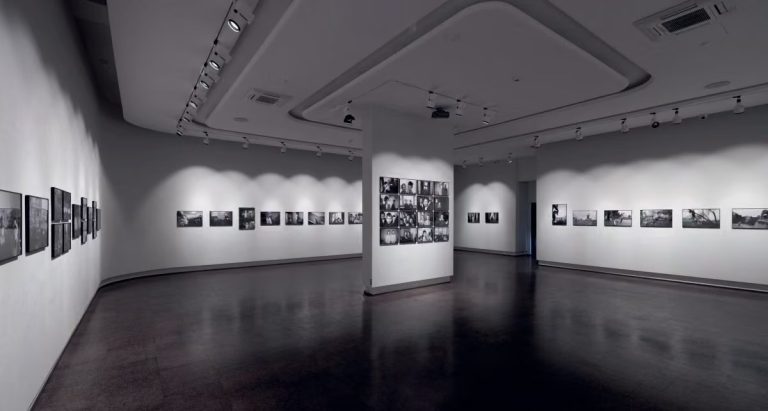
It is precisely with images of Vilnius that the artist’s exhibition Listenings, on view at the Prospektas Gallery, begins. The gallery’s initial space is occupied by the series Looking at Windows (1979). It presents window tableaux mostly from Užupis, with subject might appear to delight any voyeur, yet the curtain is never drawn aside, and the observer always remains on this side of the glass. At most, we glimpse an edge of lace, a plant catching sunlight on a windowsill, snow trapped between panes of glass, or solitary Christmas ornaments embedded within it. A kind of post-Christmas blues. Kunčius seems less interested in the life unfolding behind the glass than in how fragments of that life are framed by the rectangular geometry of windows – how they bisect a potted plant, how natural light falls across them. At times, identification with the artist becomes possible: Looking at Windows V briefly confuses me into thinking that the silhouette reflected in the photograph might be my own, until I finally realise that it is Kunčius himself. Travel through space and time occurs differently here – through an awareness of how much Užupis has changed and continues to change, a place where wooden window frames and stiff lace curtains have almost entirely disappeared. Wooden windows have been replaced by plastic ones – and in those, snow can no longer linger (at most, moisture condenses).
Yet Listenings is not only, nor even primarily, about Vilnius. Nature and its attentive, time-resistant observation emerge as the exhibition’s central figures. In the cycle The Book of Clouds (1993–2023), the sky assumes a multitude of forms and, at the same time, multiple modes of existence within photography. Heavy clouds gather and then disperse. Cumulus gives way to cirrus – they become fans or billowing tails, portending either apocalypse or dream. Elsewhere, trees burst into blossom – even the absence of colour cannot restrain them; petals fall and scent the air all the same. Then leaves are shed entirely, leaving behind stark, dark incisions in the image. Blooming resists withering and decay, and vice versa, yet both are rendered with equal care. Plants are viewed through a magnifying glass, attention fixed on the smallest detail – a curve, a depression, the texture of a leaf or petal. Eventually, the gaze retreats once more to observe the landscape from a distance. Kunčius is in no hurry: he looks around, listens in, he wanders and waits. And he knows how to wait, how to endure. He walks through forests and meadows, lifts his eyes to the sky, gazes dreamily at a cabbage leaf. And I find myself envying him just a little.
The exhibition’s unhurried tempo and tone are especially welcome after stepping in from the Christmas bustle of Gedimino Avenue, with people rushing past, lights flashing, and wind battering everything in its path. A clear exhibition structure also contributes to this sense of slowed time – the viewer is guided steadily through the images, without thematic distraction. When you look at clouds, you lie belly-down in the grass, legs kicking idly. When you wander through Markučiai, you push through undergrowth, sharp twigs almost scratching your hands and face. When you approach the plant portraits, your fingers seem to brush the soft, dense fuzz enveloping leaves – I am convinced that Imogen Cunningham herself would have delighted in such images.
Here, another of Kunčius’ strengths comes fully into play: the works almost provoke a tactile response. Take, for example, the photograph Reminiscences, 12 (1980). It depicts a tulip blooming against a concrete wall (red, I imagine?). The flower’s petals, smooth and reflective of light, resemble silk slipping between one’s fingers. Its leaves, as if lightly dusted with frost, appear velvety to the touch. Behind the flower, the concrete wall juts out, clearly coarse and abrasive – a careless brush of the hand while passing would leave a scrape. Much like hurrying up and down school staircases. One photograph – three modes of touch. The pads of the fingers rejoice. And then there is a band of light enveloping the tulip, highlighting it, elevating it almost to the level of a Baroque Madonna! Here, the eyes rejoice as well.
Kunčius certainly does not lack visual finesse. The contrasts he has mastered, along with the transparency of the print, allow subtle tonalities and halftones to shine. It feels as though layers of tone could be sliced like cake, each revealing something intriguing. Another crucial role is played by the colourful (monochrome only in its physical form) and lush photographic language used by the artist – Kunčius is able to grasp the environment by the tail, catch hold of its details, and compose them within the frame so that the image begins to speak of something beyond itself. It is through such seeing that clusters of submerged stories and modes of being are formed.
At the same time, it would be impossible to imagine Kunčius’ photographs as the product of a good eye alone – something more is required. Hence, the artist’s practice seems to revolve in a kind of enchanted circle, where without alert feeling, seeing would be insufficient, and vice versa. Both are present in abundance. As a result, nature and old Vilnius alike come alive, and we, the visitors, are allowed to become unhurried loiterers, observers of the world who, while walking, unexpectedly stop and, struck dumb, realise: I am alive!
Until 2025 January 11, Prospekto Gallery (Gedimino Ave. 43, Vilnius)