‘Silver Girls’: Baltic Women Photographers Emerge from the Wings of History
Baltijos fotografės išnyra iš istorijos užkulisių
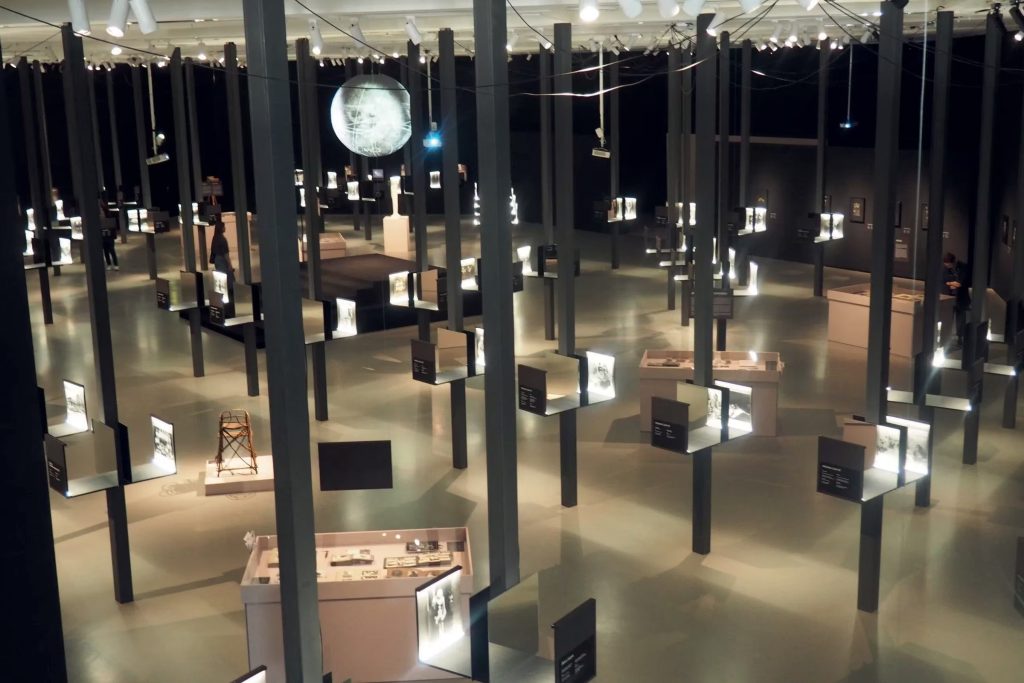
At the National Gallery of Art, it is always a pleasure to begin viewing an exhibition from the balcony – from a panoramic perspective. This exhibition resembles a forest: the viewer is greeted by column-like trunks with a canopy of photographic foliage. In this forest, one seems to hear the rustling voices of women photographers – unheard until now, yet suddenly brought back from oblivion.
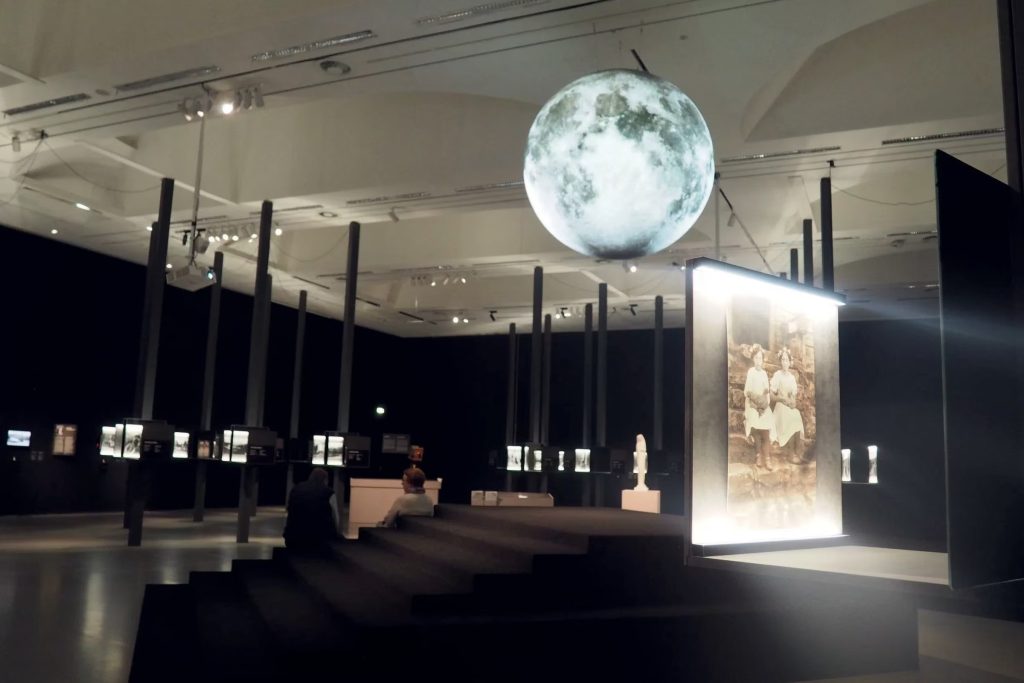
From a panoramic view, the forest impression is reinforced by a large suspended moon, across which projections glide one after another, while the reclaimed female voice is whispered by the soundtrack used in a performance. This moon, together with the spoken manifestations and the stair platform, is an archival artefact of Goda Palekaitė’s performance Lunar Sisterhood, shown on the opening evening and still alive within the exhibition.
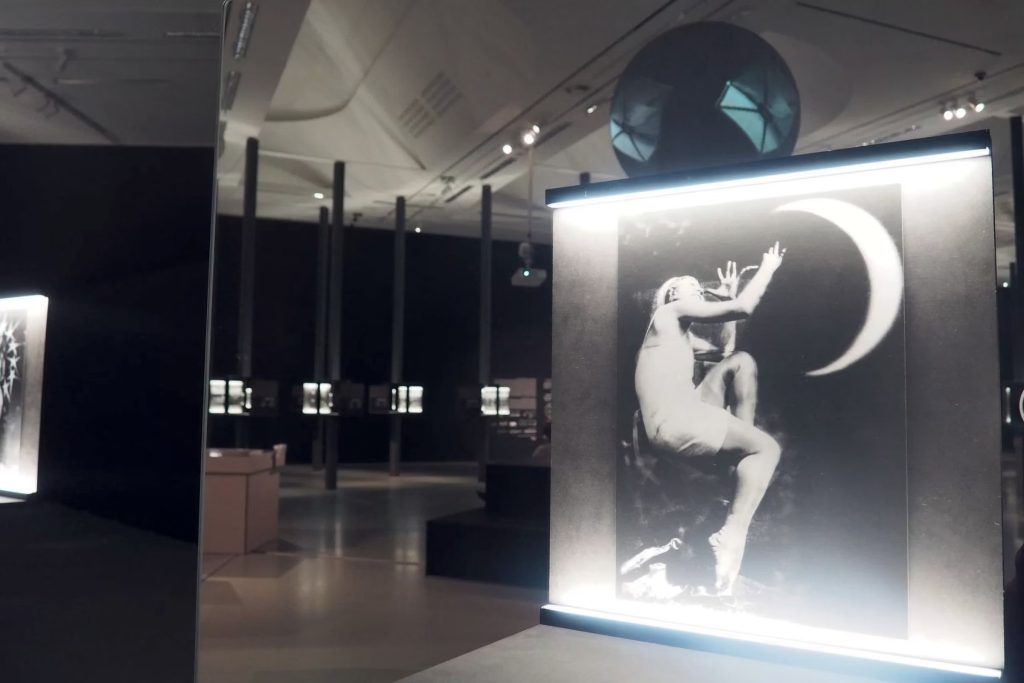
As stated in the performance description, early Baltic women photographers, who in reality most likely never met, engage in a fictional dialogue in Lithuanian, Latvian, Estonian and English. They speak poetically about celestial bodies, the female body, invisible labour and photography. Interestingly, many of the photographers presented here worked quietly yet confidently and creatively. In the early twentieth century, many women were employed as retouchers, printers or assistants. In isolated cases, they nevertheless succeeded in establishing their own photographic studios. The exhibition includes both successfully completed commissions by these women and photography created in their leisure time, in pursuit of artistic status. Hanging on the trees of memory are also the fruits of even earlier generations of women, from upper-class circles, for whom photography was a leisure activity. In the exhibition, mirrors play a significant role. Viewing the photographs directly is not always convenient; it is often easier to examine them in the mirrors installed opposite the works.
This is an intriguing architectural solution that gives the exhibition a very distinctive face. This slightly playful element carries a strong symbolic charge. As noted by art historian Agnė Narušytė, curator of the Lithuanian section of the exhibition, the mirror was crucial to the invention of the camera and photographic technology itself; mirror cameras, containing a small mirror in their construction, still exist today. The mirror is also an object of debate regarding photography as a bearer of truth.
How accurately is an image reflected in a mirror? And how accurately in a photograph? In a mirror we see our reflection; in a photograph we see both personal history and a reflection of society. How precisely is history reflected through photographs? This exhibition functions as a form of historical correction, editing and retouching – not by moving away from something, but by approaching greater representational accuracy in the history of photography. It performs the opposite action to that of digital retouching software, where reality is beautified.
The figure and story of the Estonian photographer Lydia Tarem may be seen as essential attributes of the exhibition. From the age of fifteen she studied in a photographic studio, later worked there, and eventually opened her own. She had herself photographed with her husband by a Christmas tree, and also captured herself in a wardrobe mirror. These are both the origins of contemporary selfie traditions and a highly symbolic recurrence of the mirror motif within the exhibition. Tarem was deported to Siberia and lost her husband. After a long hiatus, she again photographed herself in a mirror – returning to tradition, but in a completely different appearance and atmosphere, with a certain sense of nostalgia, mourning and melancholy.
The photographs and the lives of their authors encountered in the exhibition vary greatly. As a result, the exhibition’s aesthetic coherence – even a certain uniformity achieved through identical formats and mirrored presentation – does not become intrusive or monotonous. Within the rather monochromatic exhibition landscape and subdued atmosphere, vividly coloured and striking stories unfold.
Aleksandra Jurašaitytė-Vailokaitienė inherited a photographic studio from her father and documented the activities of the Lithuanian Society for the Relief of War Sufferers, founded by the National Revival movement. Her photographic practice ceased after she married Juozas Vailokaitis, a wealthy businessman and member of the Council of Lithuania, and moved to Kaunas.
After the First World War, Latvian photographer Marta Pļaviņa built her own photo laboratory. Her legacy has been exceptionally well preserved – nearly two thousand glass negatives and numerous paper prints. Alongside passport photographs and studio images are intriguing experiments involving mirrors and retouching.
Pļaviņa’s photographs struck me as particularly distinctive: theatrical portraits with unusual angles. Flowers recur in at least several images. As Narušytė explained, the portrait Woman with Flowers, depicting a woman with unconventional facial features, is very well known in Latvia, while the image Woman from Behind, showing a woman bending deeply into a bouquet, became the exhibition poster. The woman’s hair and hairstyle merge with the vegetation, becoming yet another blossom.
The floral motif was of great importance to Šelda Puķīte, the original initiator of the exhibition concept. The Silver Girls project was first realised on a smaller scale in 2020 at the Tartu Art Museum. So flowers, an ostensibly clichéd symbol of femininity, acquire different meanings here. They function both as a catalyst for Pļaviņa’s creativity and as a concentration of injustice and the absurdity of bureaucratic procedures.
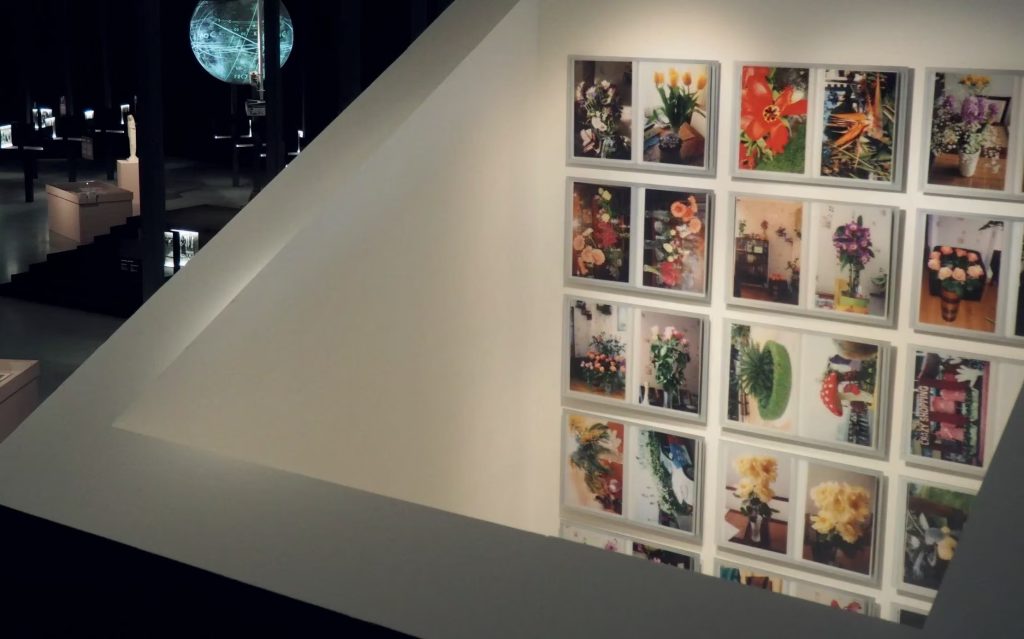
The latter meaning is unfolded by Diāna Tamane. In a house-like structure within the exhibition, the artist presents her grandmother’s story. This architectural solution separates Tamane’s temporal context – she is a contemporary artist – from the historical material. Her grandmother was accused of smuggling when crossing the Latvian-Russian border carrying two flowerpots intended for her husband’s grave in Abrene, a territory formerly belonging to Latvia and now part of Russia.
In this anthropological work, Tamane records her grandmother’s memories and story in a stop-frame video.
Inside the house are displayed a childhood farm plan, a border guard protocol, and large photographs of various flowers. These were taken by the grandmother herself, and the images are hung exactly as they appeared in her photo album. The house’s form and context dictate the theme of home, symbolising how political processes in the public sphere intrude into personal life, altering it and transforming the very form, concept and experience of home.
Only an oak tree remains of the childhood farm, recalling the artist’s grandmother, and remembering German soldiers and subsequent upheavals.
Alongside personal stories, the exhibition contains seven thematic ‘islands’. These reveal shared traits, tendencies, observations and historical emphases. The ‘High Society’ island presents artefacts produced through photography as an amateur pastime of upper-class women. Particularly striking are postcards depicting manors and palaces photographed by Paulina Mongirdaitė – herself, in fact, a professional photographer, who was even awarded a silver medal for works shown in the exhibition.
In the island of ‘Memorabilia’, Lydia Tarem reappears, her photographs documenting love with her husband, alongside her photo album. Also shown is Veronika Šleivytė’s album, containing photographs with friends, lovers and hospital staff. Particularly compelling is the somewhat abject yet deeply romantic braid of hair by Marie Riet, presented as a gift to her husband. This ornament, woven from real hair, also contains small portrait photographs stored in a tiny book-shaped box.
The ‘Phantoms’ group addresses the ghosts of history – misattributed photographs, unnamed figures, forgotten personalities and other memory glitches that can retouch history in various ways. A particularly intriguing series is the family portraits of Count Stanislovas Kazimieras Kosakovskis (Stanisław Kazimierz Kossakowski), where a woman resembling Paulina Mongirdaitė appears – but is it really her?
The ‘Sisterhood’ island highlights how women formed communities based on shared professions or interests, photography in particular. Group authorship is also discussed here. Among the images are participants of the first exhibition of Lithuanian women artists, photographed by Šleivytė. An especially interesting photograph from the history of the Latvian Photographic Society appears to depict the Women Members’ Committee observing a solar eclipse on 21 August 1914.
The ‘Photo Studio’ section reflects on how historical upheavals affected the possibility of establishing and sustaining photographic studios and the role women played in this business. In 7 meno dienos (7 Days of Art), 1928, we find an advertisement for Janina Tallat-Kelpšienė’s studio; for a time she was the official photographer of the State Theatre. The island of ‘Fates’ intertwines with the phantom theme and includes studio portraits of children, inviting viewers to search for a punctum and speculate about the lives that awaited these young subjects.
The ‘Women Artists’ island is particularly eloquent. Although not all photographs presented would qualify as artistic photography, artistic practice is inscribed in almost every biography. Some felt a pull towards drawing, others to handicrafts; some studied art and later became professional artists in various disciplines.
Special attention should be paid to the artistic photographic experiments of Domicelė Tarabildaitė-Tarabildienė. Having studied sculpture at Kaunas Art School, she created striking self-portraits rich in cultural references – with a skull, wearing Lillian Roth’s skirt, sticking her tongue out at the moon, and more.
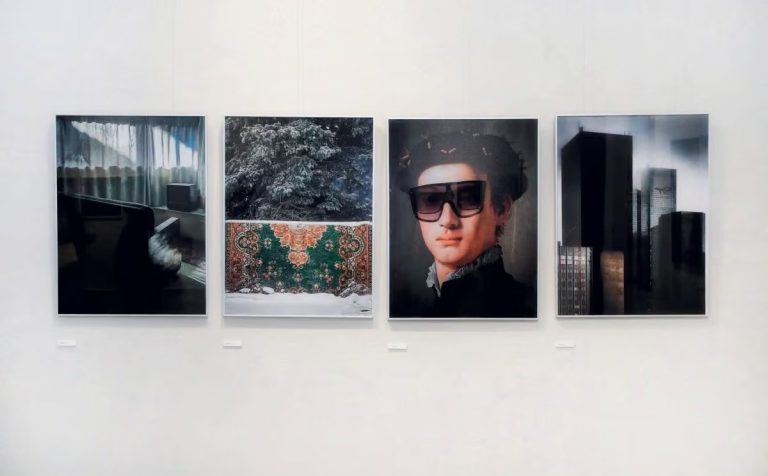
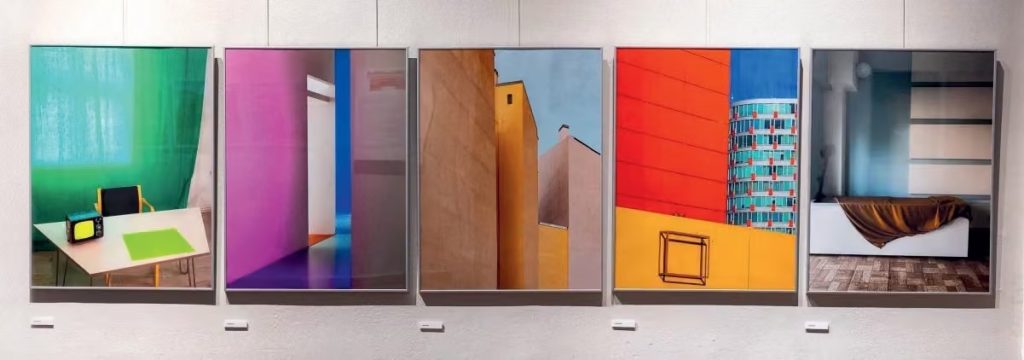
Works marked by architectural motifs of stairs, houses and walls come not from history but from the present, yet they enter into polyphonic dialogues with past creators. Behind a partition wall, the Estonian artist Marge Monko develops the concept of pleasure. In her video Sheer Indulgence, a specific choreography performed with tights references wordplay around the line of the tights, alongside the advertising industry’s sale not of products but of ideas of pleasure.
Her photograms also contain subtle allusions to historical episodes, such as the wartime shortages of nylon stockings. The pleasure of wearing stockings, dancing in them, photographing, being photographed. The advertising industry likewise provided women with opportunities to take up the camera – to photograph goods, or more precisely, beauty and ideas.
This exhibition, curated by Agnė Narušytė, Šelda Puķīte and Indrek Grigor, presents the work of as many as twenty-one women photographers. It also includes several artefacts: Tarabildaitė-Tarabildienė’s sculpture Madonna of Creation, the photographer Marie Keerd’s camera, and Antonija Heniņa’s children’s chair. These memorial objects offer a particularly evocative glimpse into past realities.
The exhibition is multifaceted yet avoids fragmentation and overload. Although at first the mirrored forest may seem disorienting, the stories soon begin to assemble into a postmodern, philosophically charged narrative rather than a chronological one. Instead of linear history, the exhibition offers whispers from three Baltic countries, from women with vastly different fates, viewing the world through the lens of their cameras.
Until June 15 2025, LNDM National Art Gallery (Didžioji St. 4, Vilnius)