An Elephant in the Museum, or in the Gardens of Photographic Imagination. Virginijus Kinčinaitis’ mobiliography exhibition ‘Deep Surfaces’ at the Vilnius Town Hall
Virginijaus Kinčinaičio mobiliografijos paroda „Gilūs paviršiai“ Vilniaus rotušėje
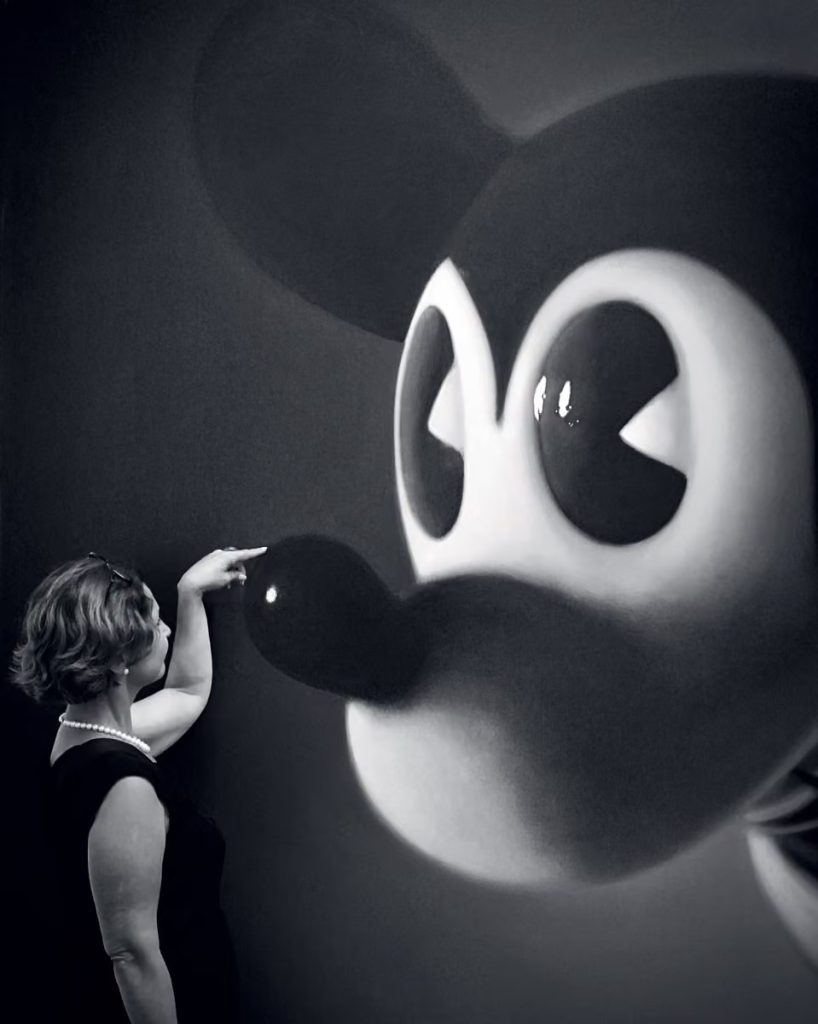
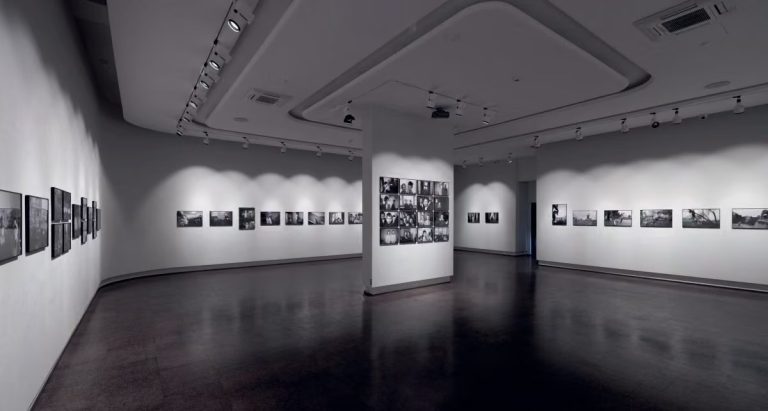
Virgis likes to travel and provoke his followers’ capacity for wonder on social media. He avoids tourist views, angles recognisable to many either in real life or online, and celebrated works studied in art history courses. Even if they do enter the frame, it is only as a detail that is deliberately enlarged, juxtaposed with some banality and presented in the ‘wrong’ format. At times an object is seen head-on and photographed with an insistently emphasised symmetry. These sonorous visual statements of the traveller, currently communicated not only on social media but also in the Vilnius Town Hall, are hung very close to one another, according to the principle of counterpoint; in many cases they become diptychs or friendly clusters. In the staged sequence, carefully assembled fragments of places, cities, dates, and occasionally even words within the images echo among themselves.
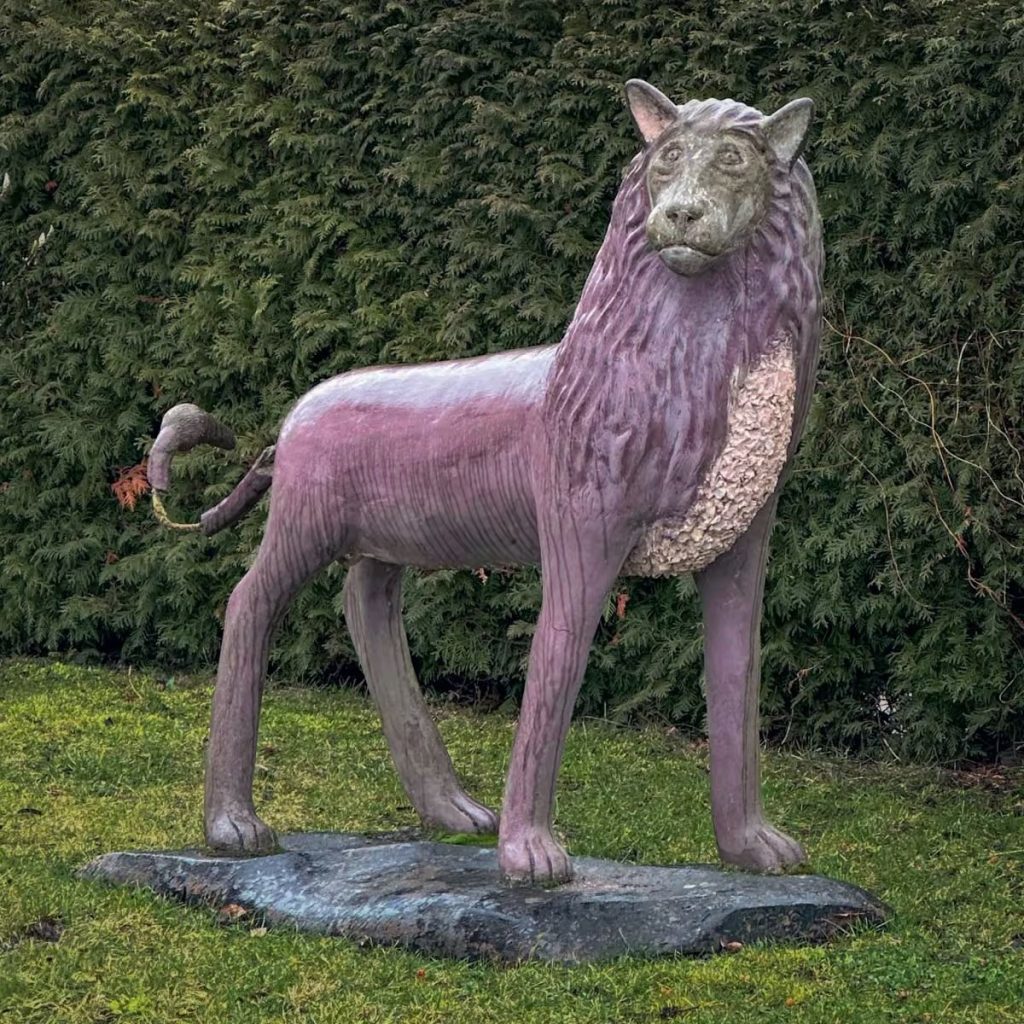
Salatrip ovich – a red advertisement on a stout Mussolini-style building in Trieste tells me something, with one letter missing in the middle. A (sur)realist elephant steps towards the viewer out of complete darkness (the title suggests it is in Vienna). Zebras huddled together and blending into one another are probably stuffed exhibits in a museum (said to be in Hamburg), while a clumsy Romanesque wooden lion has reached the Vilnius Town Hall from Šiauliai County.
All these angles, optical illusions, or artificially accentuated urban planes are parts of reality. Yet despite the blunt and laconic place names that make up the exhibition’s labelling, we would try in vain to ‘remember’ anything. As already noted, the selected images are grouped in such a way that recognition becomes practically impossible. From a construction panel and a plywood doorframe, one cannot guess the Italian location named in the title, no matter how much time one may have spent roaming around there. One may think about zoos around the world unnaturally crammed with animals, only for the next moment to bring the thought that perhaps what is captured here is some kind of outdoor shop advertisement. The art historian – and trickster at the same time – prefers to bring closer not valuable historical objects, but the figures of curious visitors to heritage sites or viewers of paintings, thus offering, from the side-lines, sociological and anthropological cross-sections of today.
The mobiliography method employed by the artist (Virgis himself does not call his practice photography) perfectly reflects the evolution of technical tricks in the second half of the twentieth century, when images became inseparable from simulation and simulacra. Graphic design developing in parallel with digitisation, the Photoshop revolution of the 1990s, and later ever newer image-editing possibilities, seemed to prove again and again that what is photographed ‘from life’ may have very little to do with what is ‘real’. The excess of images in the mass culture of the twenty-first century appeared to have finally devalued the very possibility of sincere astonishment – something we felt particularly acutely once everyone acquired smartphones with everimproving integrated cameras. In this context of digitising reality and indiscriminately ‘shooting’ everything, the travel moments captured by Kinčinaitis’ phone – an image-catcher – even cause a certain confusion. Which evaluative perspective should one choose? To which genre should these images be assigned? At a time when more than a few professionals yearning for authenticity consciously revive some analogue photographic technique, Virgis offers the gaze of a curious, intellectually witty art historian, constantly wandering about with nothing more than a phone.
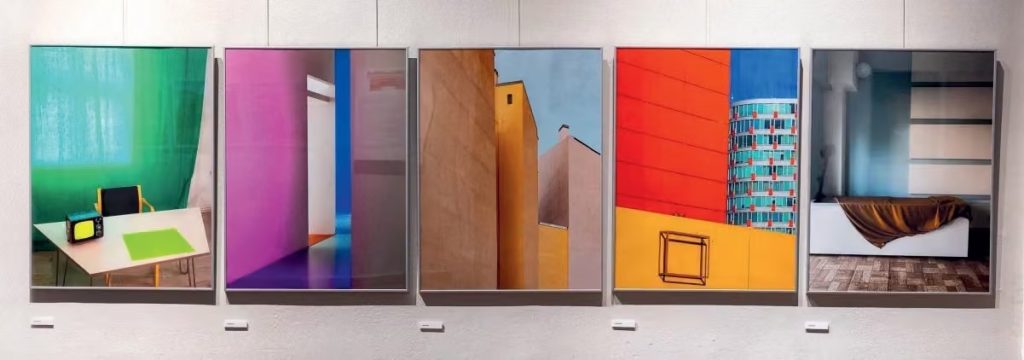
At some point I begin to follow the narrow gaps between the images along the Town Hall wall, calculated by the author down to the millimetre, and to read the labels even more attentively. I enter the proposed game with collective tourist memory, even while sensing the author’s intention to disrupt preconceived geographical knowledge. The white rectangles of titles seem to detach themselves from the wall and begin to provoke. A minimalist interior detail with a luxurious rust-coloured coverlet is titled ‘Vilnius’, while a vivid fragment of small-scale architectural exterior nearby is suddenly named ‘Pesčara’ – in Lithuanian. I would not, of course, compete with Virgis’ recollections of European names. Still, glancing at an encyclopaedia on my phone screen, I see a slightly different spelling – ‘Peskara (Pescara)’. I look again at the depicted object, realising that before me is not an advertisement for a summer cottage developer but a city in east-central Italy, in the Abruzzo region, on the Adriatic Sea at the mouth of the Pescara River, a provincial capital. In the distance, a tiny patch of sea is indeed visible. This detail of a scorching summer could occur anywhere else.
I no longer know what to believe, so I remind myself once again that Virgis’ mobile images are not meant to be believed – they are meant to be enjoyed; they are not intended to document journeys. I surrender to the directorial decision and make a second circuit of the Town Hall’s grand hall. The combinations of colours, black-and-white fragments and titles grow ever more brazen, some of them almost elbowing one another aside. A detail of a green metal war machine (in my mind I label it an old German tank) glints with menace, so I check the title and date (‘Vilnius’, 2021). Perhaps it is just as well that displayed nearby is an ancient bathtub from a regional Latgale museum, with a lace towel, exuding dignified calm. The harsh synthetic computer-game aesthetic employed in more than one mobile image is permeated by gentle humour or even a kind of shamelessness. The peeling concrete of a bluishly decorated building comes from Paris, while a room of exotic curios (though most likely just old junk) is from Šaukėnai. A toy dragon in an abandoned amusement park near Vilnius comically wraps its wings around two garage doors in the Markučiai district, set in a wall of yellowish bricks (the dragon – the framed image above, and the doors recalling classics of minimalist painting – hung with strict symmetry below). A youth with an antique face from a Florentine museum and the late Renaissance (as I assume) is ‘wearing’ sunglasses. Clearly, this is not the original painting. Perhaps it is a shop sign for sunglasses seen by Virgis, with this season’s frames fitted to the character (I speculate again)?
Looking at the images Virgis continually posts on Facebook, intellectually flirting with the viewers, I am always struck. At times, I recall something from the history of photography or cinema. And then I realise again that this scrupulous explorer of the world uses his phone to capture not the exoticism we secretly long for (according to Virgis, ‘that kind of tourist exoticism in remote corners simply no longer exists’), but our time. Following the trajectories of his thought and travels, I occasionally think about the activity of image-catching in a post-pandemic and post-travel reality. Tourism to the farthest reaches has resumed, yet their visible presence has long since been laid out across the expanses of the internet, the possibilities of ‘new’ filters (and now also of artificial intelligence) have been demonstrated in every conceivable way. Somewhere in those expanses, arguments are once again heard that definitions of photography are thinning out and ageing. After all, if we were still to associate image media in some sense not only with subjective expression and imagination, but also with an objective reflection of reality, we would have to admit that professional cameras are simply an archaic means of such reflection. Perhaps something similar will be said in the future about lightweight portable phones as well. Yet today, some of us are still ready to swap inside and outside, perform an imaginative trick with a light gesture and convince that it can be no less beautiful and eerie than that living world which, it seems, we are in fact already exhausting with all our might.
Until May 5 2025, Vilnius Town Hall (Didžioji St. 31, Vilnius)