Flashes, Distant Volcanoes, and Chestnut Blossoms. On the annual Šiauliai City Photography Art Exhibition ‘Résumé’2’ and exhibition by Geistė Marija Kinčinaitytė
Apie metinę Šiaulių miesto fotografijos meno parodą „Résumé’2“ ir Geistės Marijos Kinčinaitytės parodą
I visit Šiauliai very rarely. It usually takes an unexpected trip or a conversation with more distant relatives (and even then I tend to reach the city only in my thoughts). Even Kaunas, which is not that far from Vilnius, can sometimes seem far more distant than it really is – because of time rushing by too fast and exhibitions running for too short a period. My infrequent, though necessary, journeys beyond the borders of capitals – both the temporary one and the habitual, personally close one – I try to justify with a lack of time and with slightly longer train journeys that sit awkwardly with an ever-accelerating daily routine. Yet an invitation, together with an increasingly strong desire to escape the bustle, finally releases me from Vilnius, and I find myself in a train compartment that obliterates mobile reception. The city of Šiauliai itself does not feel particularly close to me, yet I do carry one association connected to it – a chestnut avenue. Every time I hear the city’s name, I think of it. It’s not that I have nostalgic memories there, or that anything particularly significant has happened to me in that place. It is simply that my mother, when I was still very young (and perhaps later as well), would often mention this avenue, as if fearing that one day those chestnut trees might disappear. This time, however, visiting Šiauliai not only in my thoughts, and walking along that avenue, I count not just the infinite chestnut blossoms coming into bloom and catching raindrops, but also my steps towards the bright spaces of Šiauliai Art Gallery.
On 16 May, for the second year in a row, the annual Šiauliai City Photography Art Exhibition ‘Résumé’2’ (curated by Virginijus Kinčinaitis) opened there. I did not visit the first ‘Résumé’ exhibition a year ago, so I approach the second not as a continuation but as a separate, for me still new event – full of images, of names not necessarily familiar (though many well-known ones appear too), and of visitors who, on the opening evening, filled every gallery space and all possible passageways.
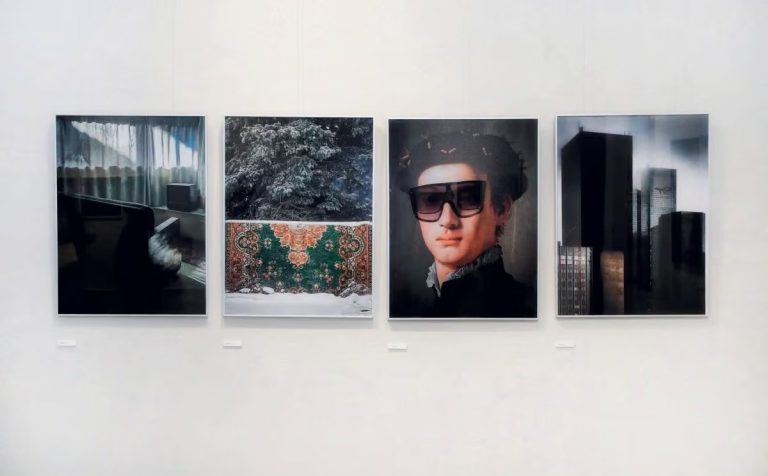
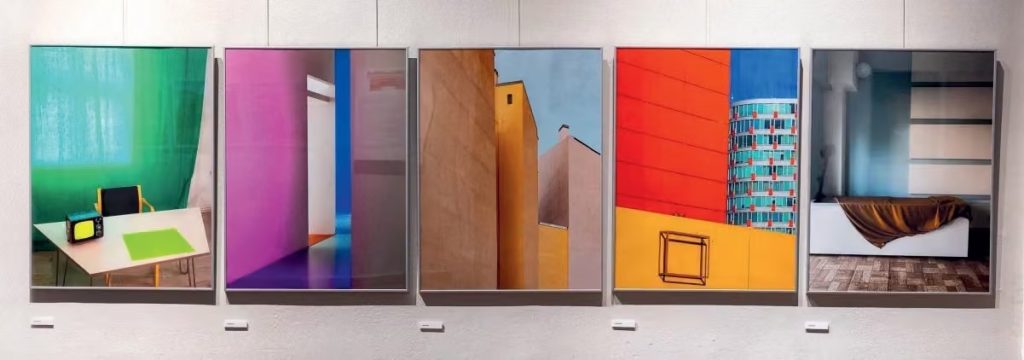
The exhibition presents photographs by more than sixty authors – every wall and corner of the gallery is covered with images. Not all of the photographers are professionals: some are amateurs, some work primarily in other disciplines and are only trying their hand at photography, others are school students, and among them all emerge the names of artists known in Lithuania and abroad, whose works already belong to museum collections. Such eclectic exhibitions are not easy to evaluate – the themes, quality, and artistic expression of the photographs vary greatly. All the authors are connected by just one axis: they are related in one way or another to the city where the exhibition takes place. Some were born here and later moved away, others still live, work and create here, while some arrived from elsewhere. So one could say that for just under a month, the gallery spaces host an exhibition of (former and current) Šiauliai residents’ photography – in its composition, scale, and eclecticism reminiscent of a salon, albeit a more modest one, yet still very important for the city (though my eyes, accustomed to slightly more minimalist displays, would welcome a bit more breathing space). And so, to answer the question that concludes the exhibition text – ‘Is this not a sign that the city is already in need of a photography festival?’ – the response seems simple: this exhibition and the events accompanying it are gradually and naturally turning into exactly that anticipated festival. Or at least into a city-wide photography celebration.
If, reflecting on my visit, I were to try to recall and consider all the photographs by all the authors, it would take an endless amount of time, so I will dwell only on the images that left the strongest impression. Here archival material merges with portraits, observations of the city’s present and history, landscapes, and other artistic investigations through photography. Rūta Černiauskienė looks at fenced-off corners of the city undergoing reconstruction (the series ‘City Readings’, 2022–2024). In several different rooms, Vilijus Žagrakalys repeatedly appears with his series ‘Lived Through’ (2016–2025), documenting buildings and ruins that bear traces of passing time. Regina Šulskytė’s collages of present and past memories (the series ‘My Time’, 2011–2013) bring together different temporal layers into a single photographic plane. Virginijus Kinčinaitis, through his mobile photography (the series ‘Museion’, 2022–2025), takes viewers along on his travels and into spaces observed almost secretly – in museums or in more secluded corners.
This exhibition also includes a work by Mindaugas Lukošaitis, ‘Striped Sky’ (2025). An artist best known for exhibiting vibrant drawings and their series, here he combines his characteristic sketch-like expression with photography, creating an installation. The puzzle of ink, brown paper, and photography constructs an image of a sky (not) seen through leafy treetops.
Portraits are also abundant in the exhibition, with several series standing out. Daiva Šeibelienė (‘Rain Windows’, 2017–2018) looks at bus windows and the passengers sitting behind them as if trying to guess whether they will notice her photographing them or not. In Deividas Buivydas’s photographs, it seems that he is getting to know the passers-by he photographs. Only in that moment do his gaze and that of the people caught in the images meet, as he captures rapidly changing emotions mixed with surprise. Meanwhile, Mažvydas Prokopovič (‘Different Homes’, 2021) enters various homes where people with disabilities live, documenting their lives while trying not to disturb the everyday routines.
As mentioned earlier, I felt that the exhibition could have benefited from more space for the works to breathe more freely, but I understand that this stems from the desire to create the broadest, most diverse, and most complete kaleidoscope possible of the city’s photography and of the people closely connected to it, seen from all sides. The exhibition reveals a variety of perspectives, transporting us not only to different places but also to different times. And this exhibition is not even the only sign that photography matters to Šiauliai. The city is home to Lithuania’s only Photography Museum.
Nor is this the only photography exhibition currently on view in the city. At the aforementioned museum, Geistė Marija Kinčinaitytė’s exhibition ‘The rocks are slippery’ is on display, extending what was previously shown in Vilnius at the Vartai Gallery in the exhibition ‘Littered with Black Dust’. By photographing the harsh lava fields of Iceland and their tactile geological fragments, the artist juxtaposes them with imagined visions of unfamiliar, unseen planets that have nonetheless been subjected to attempts at exploration. Frozen lava streams, both in the photographs and in a video work flickering on the wall, balance on the boundary between scientific precision and mystical secrecy – is this a place we will dismantle piece by piece until it collapses, or a new cosmic space to which we will flee when nothing remains?
On my return to Vilnius, I thought not only about the multitude of photographs I had seen, but also about small pieces of lava, ejected by a volcano and hardened, still lying in a little bag at my home after a trip several years ago. Now, in my mind, they merge with the images seen here and become something like long-overdue gifts finally given to myself. And to make this bundle complete, once I am back near home, I pluck a few quickly shedding chestnut blossoms, as if pretending I brought them back with me from Šiauliai.
The publication of the article is financed by Šiauliai City Municipality
The annual Šiauliai City Photography Art Exhibition “Résumé’2” – until June 7 2025, Šiauliai Art Gallery (Vilniaus St. 245, Šiauliai)
Geistė Marija Kinčinaitytė’s exhibition “Slidy Stones” – until June 29 2025, Museum of Photography (Vilniaus St. 140, Šiauliai)