‘Swarm’: How the Particular Becomes Collective
The exhibition Swarm is not the late Andrius Grigalaitis’ hornets’ nest, nor does it consist of stories about bees or constellations. Swarm is the centrifugal unfolding of seven artists’ ideas in a specific space, at a specific time. An aggregation of art artefacts at the Marija and Jurgis Šlapeliai House-Museum.
While preparing the exhibition, I was interested in the movement of artists’ thought, the diversity of perceptions, the migration of the creative process within the interval between ‘much’ and ‘little’.Iaskedwhatkindsofaccumulations,densities,concentrates, conglomerates, discoveries, losses and pauses are possible within individual artworks, and what details and nuances emerge when they are exhibited together. I was intrigued by the ‘much–little’ dynamics of contemporary works when shown in the historic space of the Šlapeliai House-Museum, rich in arches, niches, supporting beams, columns, stairs, etc. Immersed in the flow of curating the exhibition, I consciously paid attention to details, coincidences and omissions. I created conditions for the particular to become the collective, and I myself was in the state described by psychologist Mihaly Csikszentmihalyi as flow.
For example, I went to Gintarė’s place to collect Andrius’ works on a Saturday afternoon, as evening was approaching. In the bright room with a balcony, I saw them again – those hornets’ nests. We found white gloves and started framing. The photographs are handmade, unique prints. A realisation settles in: they are singular – printed by Andrius himself.
Silence. Only birds. Spring. Everything goes smoothly for the two of us. I lift the photographs wearing those white gloves, while Gintarė does everything else. We remove Andrius’s earlier black and-white landscapes from the frames. Into the newly freed square of the mount we place the photographs for the exhibition. Andrius’ authorial technique, his authorial gaze. I notice that on the reverse side of the mount a black and green background with red lettering repeats. I keep reading the word ‘Spin’ as ‘Spain’… That unexpected colour contrast is striking. A thought arises to exhibit the other side of the mount as a component of the image within the frame. The photograph, its back, the mount, the cardboard printed with ‘photographer Andrius Grigalaitis’, and even the metal fasteners tightened with a light twist – all of this forms a multilayered materiality of the work, which I like to think about in the way Milorad Pavić liked to write about the inner side of the wind in his novel of the same title. The invisible side… The idea arises to exhibit that as well.
Since there are exactly as many mounts with green backs as there are photographs intended for the exhibition, I photograph them… just in case.
At home, while composing a ‘collage of the other sides’ from six, seven, eight, nine photographs taken that day at Gintarė’s, I remembered my swan (the one now in the exhibition), because for a long time it had a pattern of white circles hanging on it (a scarf hanger from IKEA). More precisely, I remembered that combination of the swan and the circularrings, which used to tickle my vision and promise some kind of mystery I wanted to unravel. Perhaps I have unravelled it now? Because those round shapes became so strangely, accidentally connected across time and space…
Or: almost all of us had already brought, transported and arranged our works – swarmed them into the exhibition. Justina Gražytė and I finished installing her Pelargonium odoratissimum (2020) from the project 2052 about the leisure of lonely seniors, presented at the VDA Gallery Akademija in 2022, and my swan from the 2014 photo album Gold and Fish, in a sixteenth-century cellar: perfect company, a bird and a flower. Suddenly, in one of the arches, we noticed a thick, shiny nail – how could you not hang something if there is even a nail? This is how my three untitled artefacts appeared (why would they need a title), and even without authorship (why would they need that). So simple, neutral, complementing the conspiracy between the swan and the pelargonium – deepening it. This is how the flow worked.
Entering the flow while creating the exhibition brought a lot of pleasure and enjoyment of what I was doing. As a result, on the ground floor, the works, cycles and series by Justina Gražytė, Andrius Grigalaitis, Danielius Samulevičius and Gytis Skudžinskas found their places – laid down, hung, leaned, adhered beautifully. Below, in the cellar – Gulnara Galiachmetova, Tomas Andrijauskas, and the aforementioned works by Justina and myself. And the exhibition began to sound. Like a well-tuned piano sounding in a space that does not dampen the acoustics.
Avoiding descriptions of the exhibited works and aesthetic insights focused on form, I wanted to learn about the intentions behind their creation, to ask the participants themselves: how did their works come into being? Artistic intention is the conscious aim of the creator to convey a certain meaning, idea or emotion through an artwork. Intention itself, even if it expresses an unequivocal truth, provokes interpretation. Some art theorists argue that the author’s intention is an essential condition not only for interpreting an artwork, but also for the formation and perception of meaning.
Intention as a philosophical concept is particularly prominent in phenomenological and existential philosophy, where the artist’s experience is treated as a fundamental condition of the work’s meaning. Edmund Husserl’s phenomenology emphasises the intentionality of consciousness as the basic structure of creative experience. Jean-Paul Sartre stresses art as an existential form of freedom, in which intention becomes an act of responsibility. Arthur Danto highlights the conceptual dimension of intention, where the artwork depends on the conscious embodiment of an idea within a cultural context. Maurice Merleau-Ponty understands intention as a sensory experience of the world that becomes expressed as an artwork. These four perspectives complement one another and allow us to state that artistic intention is multilayered: it can be conscious, reflective, pre-reflective, manifesting through bodily sensation. The artwork then becomes not only an object of aesthetic appreciation, but also an expression of the being of the person who creates.
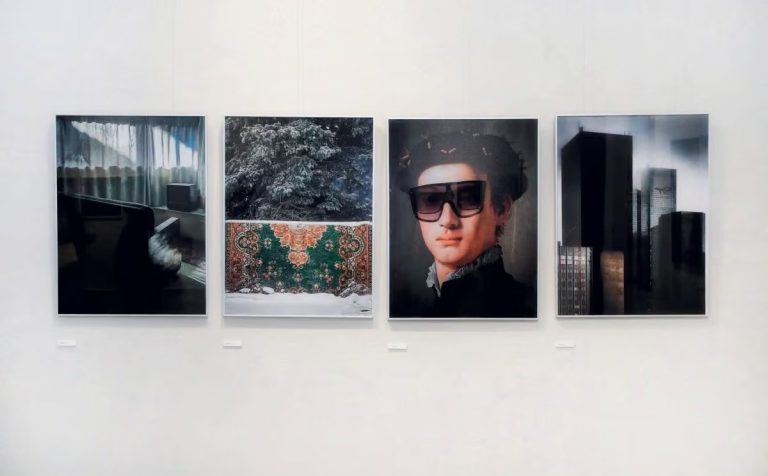
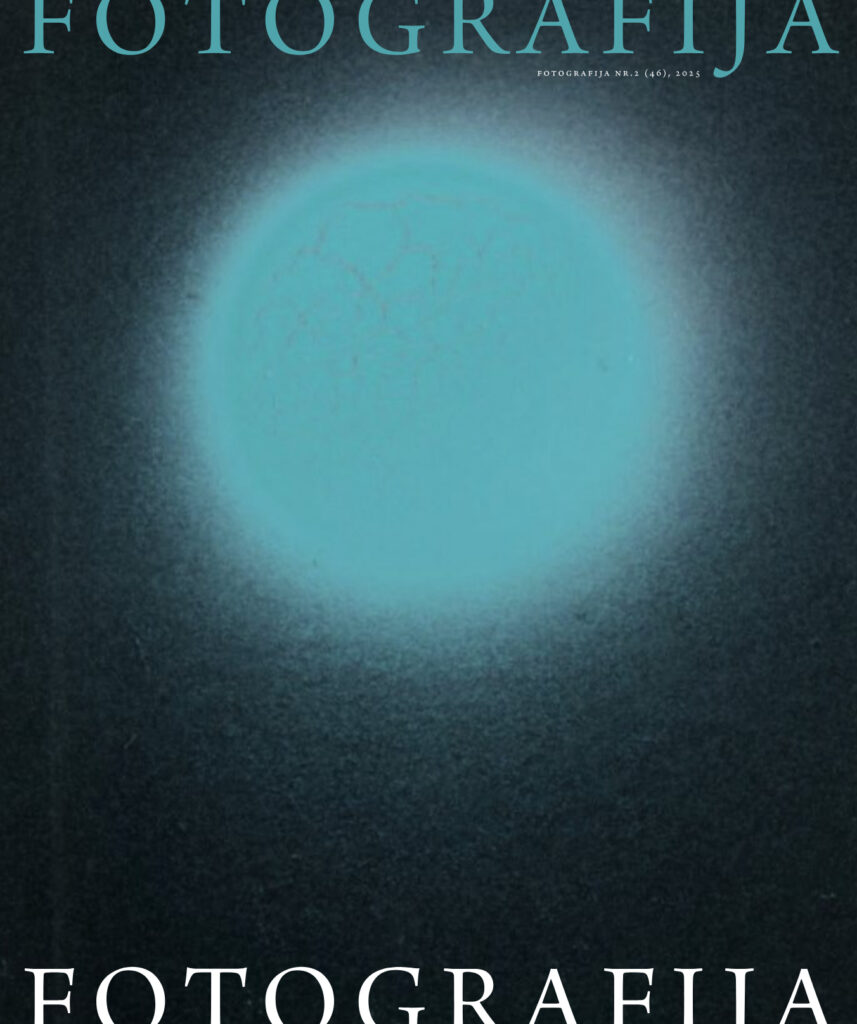
Such could be Gytis Skudžinskas’ silver gelatin prints using his authorial technique with acrylic paint, Full Moons (Sydney Diary) (2025), created in Sydney while enjoying or marvelling at the turquoise colour dominating the metropolitan landscape. Luminous turquoise moons in a mysterious natural landscape, almost like a jungle (as Skudžinskas notes, ‘it is the only metropolis I have seen that has jungle motifs within the city’), generate tension and call for an Antonioni-like blow-up. On his Facebook page, Gytis writes: ‘I mark as “diary” those things that arise from everyday practice, from recording experiences, marking trajectories… Such pre-linguistic, not-yet-articulated maps of experience. My own objects of discipline… Objects that emerge from texts, encounters, passion and the search for self-definition.’
The principle of intentionality formulated in Husserl’s Ideen zu einer reinen Phänomenologie… (1913, 2009) becomes the basis for analyses of artistic consciousness. In his view, the artist’s consciousness, when creating a work, is directed towards a certain object or idea – real or imagined. The artwork, as an expression of subjectively lived, intentional experience, conveys the world that opens up in the creator’s consciousness, which the viewer later ‘reads’. Such are Andrius Grigalaitis’ authorial silver gelatin prints, where what appears after long observation through a telescope or microscope in the dark of night is nothing other than the author’s need to express, in this way, his coexistence with the hornets settled on his homestead. ‘Consciousness is always consciousness of something’ (E. Husserl, 2009).
Husserl’s intentionality was later developed in the works of Sartre, especially Qu’est-ce que la littérature? (1948, 1985), where he treats intention not only as a conscious act but also as an existential stance – a choice to speak, to participate and to create meaning. ‘Writing is an appeal to the freedom of the other’ (J.-P. Sartre, 1985). According to Sartre, through their work the artist provokes the viewer to interpret and to assume responsibility. Intention here is not merely a message, but an invitation to co-create. This could be reflected in my installation Swan, as what is exhibited is not so much the work itself as my imagination of it, my belief in it as a symbol…
‘I have exhibited that black swan I saw in Belmont several times. In various formats, on various surfaces. After its publication in the 2014 album Gold and Fish, I believed in this photograph, because it was easy to turn it into a sign, a logo, a print on a T-shirt – a symbol. At home, its image hung for perhaps ten years and seemed to merge with the wall of the little room where I work. It absorbed the warmth of the stove, the rays of the evening sun, the glow of the monitor, the cat’s purring, the smell of smoke, dust, dreams, strategies and tactics. Each time I look at it, I see a greenish reality that, like long-aged wine, acquires flavour. If I were to print that stillness of the swan’s image on ordinary postcards in an edition of a thousand and one nights, bundle them and exhibit them in a show, would I extract, preserve more of that stillness (that being)? Would I share it more effectively?’ (from the exhibit text).
So, according to Danto, what the artist wanted to say depends on the idea he wishes to embody in the work, on the work’s insertion into the art world, on its relation to other works, tendencies and the epoch. In Danto’s texts, especially The Artworld (1964) and The Transfiguration of the Commonplace (1981), intention becomes a central conceptual notion for distinguishing art from non-art. Yet without an artistic context, intention loses its power to convey an idea through a work. ‘Art is embodied meaning’ (A. Danto, 1981). Justina Gražytė’s ellipsis To Be Continued… from her first solo exhibition of the same title at the VAA gallery Artifex in 2019, which caught my attention while outlining the exhibition, resonates with Danto’s idea. Without the exhibition context, it would be simply three cut-out and stitched fabric circles glued to a wall. Now it is a work that, in the context of this exhibition, illustrates eternal temporariness. As the artist herself notes, ‘it was a random element of my first solo exhibition / an ellipsis / a wish to myself / a moment / an experiment… which over time has “grown”, gained autonomy and become a kind of my calling card’.
Maurice Merleau-Ponty writes about artistic intention deeply embodied in seeing the world – intention that may not only be a plan or an act of the mind, but also a sensory, perceptual (not necessarily articulated) orientation in the world – in Phénoménologie de la perception (1945, 2018) and L’Œil et l’Esprit (1961). He emphasises perceptual experience as a fundamental prerequisite of artistic creation. ‘The painter gives the body to vision’ (M. Merleau-Ponty, 1961). Such could be the videographic works by Gulnara Galiachmetova and Tomas Andrijauskas. In Gulnara’s case, what unfolds is the pre-reflective intention distinguished by Merleau-Ponty – when the artist ‘lives through’ the world and ‘allows the work to be born’ through experience. Galiachmetova writes: ‘I recorded moments when nothing had yet happened, but something was already felt, without a goal – I would simply stop when I sensed that what I was seeing was speaking to me. The moments I filmed never arose in calm but in motion – in everyday life, bustle, domesticity. They occurred like quiet fissures between actions, like breathing pauses, where the image becomes space and silence becomes an event.’
Silence and the dynamics of movement in Gulnara’s compelling video work Intervals Between Nothing and Something (2025) explore shifts of time and attention. As the artist states, ‘while editing, I realised that there was no effort on my part at all – only sensitivity to the moment. And faith that this is enough.’
In the case of Tomas Andrijauskas, what occurs is the reflective intention defined by Merleau-Ponty – when the artist consciously reflects on what he wants to convey. Tomas writes: ‘How did the abstract film / video artwork Dust come about? Constantly moving through genres, trying to renew myself, I realised that I was lost among searches for my true identity. So in my thoughts I tried to return to my youth, to the time when the understanding that I am a creator was forming. The starting point was one memorable summer’s day when, unable to contain myself, I stretched 16mm colour and black-and-white film strips on the asphalt in the yard and sprinkled them with chemicals that etched the film and formed random drawings / images. I thought: why not try to repeat that day after more than thirty years.’
In Andrijauskas’ work, real images filmed in a garden (flowers, swaying raspberry canes, hibiscus…) are combined with an unfilmed reality that took shape through physical damage to the film. From this filmed and unfilmed reality, yet another authentic reality emerged, involving not only the author but also the viewer.
Let an excerpt from Danielius Samulevičius’ poetic account of how he created his triptych – which unexpectedly visualised my often a priori posed question ‘How to see sound, how to hear colour?’ – be the beginning of yet another story… With technological precision and through photography, he visually decoded Sūduvian shepherds’ herding calls, an Aukštaitian sutartinė and a Dzūkian lullaby. He did so with great attentiveness to colour and sound; the result is colourful combinations of sounds reminiscent of folk-art patterns. The ‘running line’ created by a projector is an interactive element of visual thinking.
‘How did the work come into being? Oh, it was like wind through fog – you don’t feel it when it starts blowing, but you see the branches tremble. I ‘dropped’ sound into the computer, and it went on to ‘show’ me colour. Was there an initial idea? There was. But not like an architect’s – rather like a sower’s. ‘I’ll sow it, whatever comes will come.’ Not every thought needs to be clear – sometimes it’s like steam over a lake in the morning.
How did it develop? Like an apple tree after frost: first it was bitten, then it produced different blossoms. The process was more about listening than control – the work itself ‘said’ what needed to be shown. Did the result move away from the beginning? It moved away like smoke from a stove – at first it was one thing, then it spread, permeated. But you know what? Sometimes smoke reveals that it is not what you planned that is burning, but what you forgot. About the creative process? One day I imported sound, and an image appeared. Like a seed dropped on a windowsill – it grew without permission, but beautifully. Accidents, discoveries? Sometimes the mouse button sticks – and then you see what you yourself would have missed. Once a colour came out not where it was supposed to, but it stayed there. And it did the right thing. Where did the idea come from? From quiet listening. Sound speaks to a person – we just often don’t hear it. I allowed myself to learn to hear. Like an old well – it doesn’t speak, but if you drop a pebble, it answers with an echo.’
Until April 27 2025, Marija and Jurgis Šlapeliai House-Museum (Pilies St. 40, Vilnius)