Beyond the Limits of Visibility. Akvilė Anglickaitė’s exhibition ‘Changing, It Rests’
Akvilės Anglickaitės paroda „Kismas rymo“
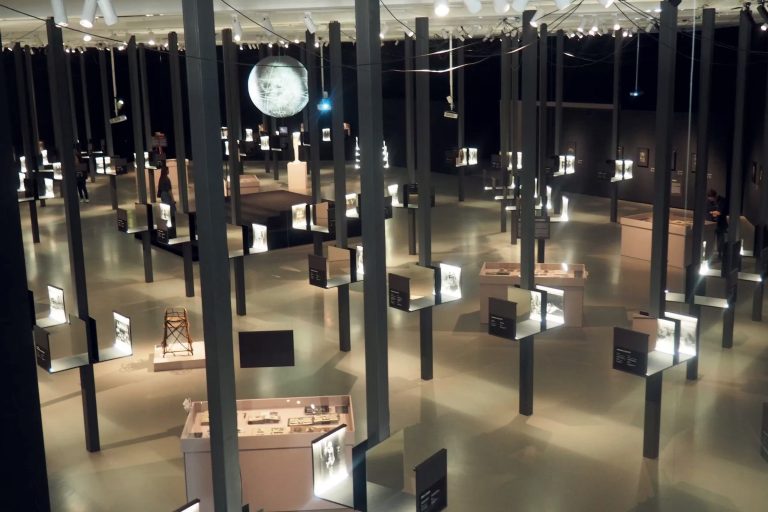
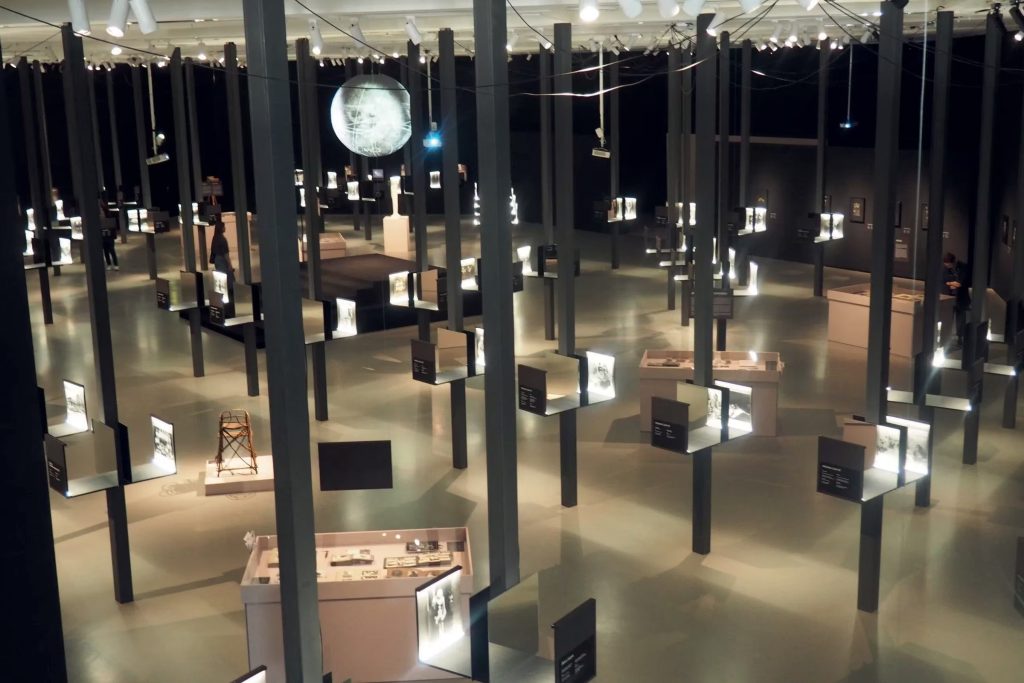
The boundaries between reality and illusion, light and darkness emerge in Akvilė Anglickaitė’s exhibition Changing, It Rests, currently on view at the Radvila Palace Museum of Art. Here, the limits of vision seem to dissolve, opening up new horizons of perception. In the photographs and video installations on display, the artist employs unusual, sometimes technically imperfect means of expression. Attention is deliberately drawn to seemingly insignificant objects such as fragments of plants or contours illuminated by light. Within the frames, bands of luminosity layer and overlap; in places, the image is flooded by white patches caused by overexposure, excess light that leaves a scorched trace on the photosensitive material. These artistic decisions, not always technically orthodox, open up a new dimension. They are no longer merely a way of reproducing reality as seen by the human eye, but become a rewriting of it, a sign of the fragility of appearance and of uncertainty. Such an aesthetic allows the viewer to sink into a subjective, hazy reading of reality.
From this sensitive relationship with visibility arises a paradox. The photographic medium, while dependent on reality, simultaneously negates it. This form of artistic expression, grounded in light, reveals that the recording of luminous matter can become not only a reflection of reality but also its contemplation. The layer of glow captured in the photographs is not merely a technical trace, but a territory of uncertainty, doubt and perceptual shifts, where the tension between technical execution and the control of luminous matter becomes apparent. This shift opens an even more fundamental question: how can photography record not only form, but the very flow of natural being? For nature is constant change, vibrating in sunlight, gusts of wind, breaths of water or in the residual imprint left in emulsion. It is precisely this ongoing transformation of nature that the images exhibited here respond to, awakening a sensation that recalls the origins of the primal image, the first opening of human eyes to the light of the world.
Light becomes not only a condition of sight, but also a metaphor for reality itself, a primordial substance without which neither vision nor understanding of the world is possible. In the photographs produced through analogue processes, light slips across the surface of the prints and dives into dimensions without time, where between what has been and what will be there is a gap, and the now has not yet arrived. Is it possible to speak of what does not truly exist? Can art depict non-being, the incomprehensible, indeterminacy? These questions open a metaphysical space in which the artist’s interdisciplinary practice unfolds as a continuous reflection on the unknowable. The play of light in the branches of vegetation turns into an abstract phenomenon that resists human control. It resembles plants submerged in water that, moving plastically, cling to the body yet at the same time constrict it. Such visibility no longer submits to human mastery – pulsing with its own will, it invites consciousness to follow, as if listening to the mute whisper of nature.
In Anglickaitė’s images, fragments of vegetation seem to dismantle the centre of human power. There is nothing firm to hold on to. This atmosphere of weightlessness subtly evokes the image of Shakespeare’s Ophelia from John Everett Millais’ painting. Among the fragments of nature, one can sense the calm gaze of the drowned woman. It is directed at us not from beyond, but from within this world, lingering at the threshold of the water’s surface. Ophelia, floating in the water among the grasses, seems to whisper: let the current carry you towards what is unknowable. Her half-closed eyes testify to a secret surrender to the rhythm of nature, and through Anglickaitė’s works a clear message emerges, that being and non-being are inseparable.
This dreamlike experience extends into the video works, where the element of water prolongs Ophelia’s state of floating, dissolving the boundary between body, nature and visibility. This is particularly evident in one video installation dominated by water. This element erodes familiar laws: sound is muffled, movements slow, sensations become fragile and fluid, as if drifting away. Beneath the water there may be nothing at all, only a trembling void in which the body loses its bearings. Watching the frames glide calmly across the horizon of vision, the viewer may descend into this state of weightlessness and find tranquility, or conversely experience inner unease, arising like an instinctive signal of fear moving against the current.
As in Millais’ canvas, water here becomes both cradle and grave, while nature draws attention into an unbroken fabric of eternity, dense, unsettling, yet alluring in its irresistible force. This motif highlights a paradox of the present. Our everyday life may appear secure, yet within it lies fragility and emptiness that only the breathing of nature can fill with the pulse of life. Nature operates here according to a hidden system barely perceptible to humans. Its unknowability becomes a force that decentralises human authority and directs us towards states of anxiety and disturbance. It proliferates within layers of time as an indeterminate vibration accompanying human existence. Only by listening closely to the rustling of leaves or gazing at flashes of light in the branches does calm begin to arise within, a rhythm that aligns with the flow of nature and turns into complete surrender to it, much like the mystery of fair Ophelia herself. She is not merely dead and passively beautiful. She is actively present, allowing the current to carry her into a new, as yet unexplored experience. Here a paradox emerges: passive surrender to simply being becomes an active way of knowing what is incomprehensible. All that remains is to hold one’s breath and watch as flickering glows seep through the pores of the fabric, like sparks of hope, signs along the path of the unknown, or fragile reflections of spiritual being. This is Ophelia’s gaze at the threshold between life and death, which in the video installation invites the viewer to experience the world’s unknowability, close to the haze of the beyond. By exploring natural phenomena through the perspectives of light, water and time, Anglickaitė opens up hundreds of intermediate states and layers of unpredictability, inviting the viewer to abandon univocal knowledge. She draws us into a space of indeterminacy, where nature is no longer a fixed object but a living, constantly changing process. The emotional and sensory impact of the exhibition naturally raises questions – what new horizons of perception might we discover if we were to relinquish the illusion that humans fully control nature?
Can art become a means of accepting this uncertainty as an essential component of our relationship with the world, rather than as a deficiency to be eliminated? The exhibition responds to this question through a range of visual forms, from abstract large-scale drawings to photographs and video installations that unfold a world of natural forms, recalling both the fragility of nature and its inexhaustible vitality. The untitled works liberate the senses and open up sensory fullness, a play between clarity and mystery. They reject singular meaning, unfolding a multifaceted significance and inviting the viewer to discover new horizons of perception.
By recording natural structures through various modes of expression, the artist highlights the human relationship with an ever-changing environment, and her practice becomes not only a visual but also a conceptual testimony to nature’s vitality and to people’s place within it. Presenting her subjective emotional and intellectual experience, Anglickaitė enables each viewer to discover their own relationship with a constantly transforming world.
Until October 12 2025, LNDM Radziwill Palace Art Museum (Vilniaus St. 24, Vilnius)