From Papilė to Johannesburg. On the exhibition ‘David Goldblatt: (In)Visible Structures’ at the National Gallery of Art
Apie parodą „David Goldblatt: (Ne)matomos struktūros“ Nacionalinėje dailės galerijoje
It took me several days to fully grasp the fact that the long-awaited exhibition of photographer David Goldblatt’s work, David Goldblatt: (In)Visible Structures, had finally opened at the National Gallery of Art of the Lithuanian National Museum of Art. I would like to express my sincere thanks to the curator Karolina Ziębińska, to the Goldblatt family, and to the gallery’s director and team for making this happen. My first email to David was written exactly ten years ago. In that message I introduced myself and asked for his help while preparing a dissertation on South African Jewish photography. A year later it was David who contacted me, asking for assistance in organising a trip for himself and his family to Lithuania. They wished to visit their parents’ place of origin, the small town of Papilė (which they referred to by its Yiddish name, Popolan) in Akmenė district. This was where David’s father, Eli, was born in 1890. Later, after moving to Randfontein, Eli bought his son his first camera. Together with my colleague Neringa Latvytė from the Vilna Gaon Museum of Jewish History, we accompanied David, his wife Lily, daughter Brenda and son Ron on this journey, witnessing how the Goldblatts encountered Lithuania for the first time in their lives.
At the entrance to the exhibition, a large photograph taken in the late afternoon of 29 August at the site of the mass execution in Papilė’s Šiaudinė Forest causes me profound pain. Behind the memorial stone, which bears an inscription in Yiddish and Lithuanian commemorating the murder of 50 Jews and five Lithuanians by the Nazis on 22 July 1941, lies a story of discovery. The site was identified thanks to Papilė geography teacher Steponas Adomavičius, who for many years collected Jewish gravestones scattered during the Soviet period. He carefully arranged them along the banks of the Venta River and planted trees in memory of each murdered family. And if in 1941 Eli Goldblatt had still been living in Papilė rather than in Randfontein, he would most likely have been among the victims.
During that visit to Lithuania (my conversation with David: Karina Simonson, ‘The Aesthetics of Apartheid. A Conversation with David Goldblatt about South Africa and Photography’, 7 meno dienos, no. 32, 18 September 2015), I introduced David to the director of the National Gallery of Art, Lolita Jablonskienė. Together we dreamed of organising his exhibition within a couple of years and inviting him to open it. Unfortunately, at that time those dreams were not destined to come true.
What followed were many precious moments. During my trips to South Africa I stayed at the Goldblatts’ home in Johannesburg, where I was always warmly welcomed at their family Shabbat dinners. I accompanied David as he drove his impressive white Toyota Land Cruiser, adapted for life on the road, watching him photograph, and visited his studio on numerous occasions. He took me on tours of Johannesburg’s most hidden neighbourhoods, eager to show what a fascinating and diverse city it is. David’s death in 2018 brought immense sadness.
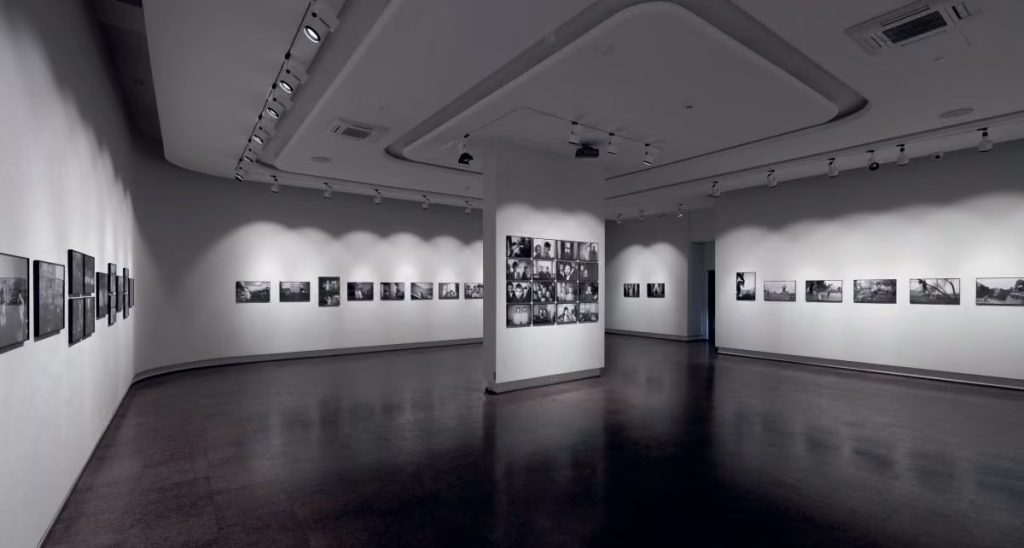
Curator Karolina Ziębińska, a leading expert on Goldblatt’s work who also curated his exhibition at the Pompidou Centre in Paris (which I discussed in my article ‘Testing the Limits of History. Three Exhibitions. Paris, London, Stockholm’, 7 meno dienos, no. 18, 4 May 2018), chose the concept of structures as the central theme of this exhibition. These are structures that shape society, both visible and invisible. The photographic series presented here subtly analyse how apartheid shaped space and how that space, in turn, affected people’s lives. Goldblatt’s gaze is not directed at shocking images of apartheid oppression, but at the structures and fragments of everyday life that reveal deep-seated relations of power and inequality. The exhibition is installed so that visitors encounter not only the photographs themselves, but also additional context – archival materials, photo albums, maps and the artist’s own comments, which bring out historical and cultural layers of South African life. Among the works on display are photographs from some of Goldblatt’s most important series, including On the Mines, Some Afrikaners Photographed, In Boksburg, Soweto and Structures. The exhibition is also visually divided. On the darker side of the gallery, in the section titled ‘Early Series’, Goldblatt’s early works are shown. At that time he was confronting the reality of his subject; today, we as viewers confront his works face to face. On the lighter side of the space, titled ‘Structures’, those intense gazes are no longer present. This is understandable, as more than forty years separate the works.
One of David Goldblatt’s earliest photographic series, On the Mines, begun in 1947, documents the complex life of South Africa’s mining industry and offers an in-depth examination of its social, economic and environmental consequences. First published as a book in 1973, the series combines Goldblatt’s black-and-white images with texts by the renowned South African writer Nadine Gordimer. His monochrome photography emphasises texture and contrast, rendering both the miners’ bodies and harsh landscapes strikingly vivid. The photographs present powerful images of mining machinery, mine shafts and the barracks-like living quarters of Black migrant workers, underscoring the dehumanising aspects of the mining system. Goldblatt avoids sensationalism. His work is characterised by a quiet yet deeply critical approach that restores dignity to the miners and their surroundings and awakens empathy. He records not only monumental industrial landscapes and the physical hardships of mining, but also intimate emotional and psychological portraits of his subjects, revealing their resilience and vulnerability. His work goes beyond documentation, opening a window onto an industry that was the backbone of South Africa’s economy for much of the twentieth century. On the Mines remains a seminal photographic series, valued for Goldblatt’s ability to see the human being and humanity where they are so often overlooked.
In the monumental series Structures, begun in 1983, Goldblatt explores the complex relationships between architecture, landscape and South Africa’s social and political history. The buildings documented in these photographs speak quietly of apartheid, colonialism and the transformations taking place in the country. Goldblatt records everything from modest rural houses to grand public buildings, all reflecting the ideologies and power dynamics of their time. His images are not only visually compelling, but also highly contextual, inviting viewers to consider how spaces are formed and how human experience is shaped in parallel. His meticulous framing highlights contrasts between privilege and marginalisation, often showing how these spaces sustain inequality. Yet beneath his critique there is always a profound empathy, focusing attention on the people who exist within and beyond these structures. This series is not only a historical record, but also a call to reflect on South Africa’s present and future. Goldblatt does not dramatise. Instead, he quietly invites viewers to recognise the ‘invisible’ structures of oppression embedded in everyday environments. By pairing images with descriptive captions, he offers insights into the layered meanings of each structure. Structures stands as a powerful testament to architecture’s role as a silent witness to history.
Some Afrikaners Photographed is one of Goldblatt’s most significant photographic series, capturing the complexity of Afrikaner identity in South Africa during the apartheid era. The images, made between 1963 and 1974, explore the cultural, social and political dimensions of the lives of this group that dominated the apartheid system. Goldblatt’s approach is nuanced and non-judgmental, offering an intimate view of everyday life. The photographs avoid overt political commentary, instead focusing on subtle visual details that reveal underlying tensions and contradictions. The series includes portraits of Afrikaners in both rural and urban settings, emphasising their relationship to the land and their role in South Africa’s painful history. In these works, Goldblatt highlights the banal yet powerful structures that sustained apartheid, from family dynamics to hierarchies in small towns.
Most of the works on display at the National Gallery of Art were already familiar to me from Goldblatt’s books or exhibitions abroad, but seeing the originals in Lithuania is, of course, a special experience. The photograph of the statue of the colonialist Cecil Rhodes at the University of Cape Town, toppled after the victory of the #RhodesMustFall movement, which is very close to my heart, is particularly striking. The severely beaten fifteen-year-old Lawrence Matjee was described to me by Ron Goldblatt – who had arrived at the police station with his father at the time and who, to this day, cannot forget the brutality of the racist system. The segregated pedestrian bridge over the Cape Town–Johannesburg railway line is a South African reality that feels painfully familiar. Although I have not seen this specific bridge, many similar urban wounds from the apartheid era still remain.
The National Gallery of Art has become a space for discussion about how we see and interpret history, how social structures shape our lives, and how art can help us recognise these structures. This is not merely a photographic exhibition. It is an invitation to dialogue and to a sensitive engagement with South Africa’s complex history. Every visitor can find room here to reconsider not only historical events, but also contemporary social relations.
In closing, as is often customary when writing about non-European art, one might add that the exhibition encourages cultural dialogue and helps us understand different experiences and perspectives. However, in my view, an exhibition of South African photography requires at least a minimal knowledge of the country’s history, something that is still sorely lacking in Lithuania. Without it, the exhibition risks becoming a kind of ‘picture-book’ of Africa and its histories of racism and colonialism, without fully revealing the nuances of the images on display.
This exhibition is deeply personal for me, both because of my connection to the photographer himself and because of the South Africa he depicts, a country with which I have formed a special bond. The emotional weight of the exhibition is oppressive, yet I hope that David is watching it with a smile from above…
Until February 9 2025, LNDM National Art Gallery (Didžioji St. 4, Vilnius)