Planetary thinking
Our relationship with the planet and how we visually perceive it has changed since the first photographs of Earth taken from space. Seen from afar, the planet became a manipulable artefact: a technological system, a spaceship, resources, models, and engineering projects. Remote observation is also inseparable from attempts to calculate the scale of the climate crisis and to analyse the impact of anthropogenic activity on ecosystems. The natural world, its fragile states, and the consequences of alarming natural forces are often perceived from a distance – through screens, simulations, and sensors that convert natural processes into data and circulating images, shaping our perception of the environment. For instance, satellites that record, measure, collect, and share data are used to predict meteorological changes and to model the future of the melting Arctic sea ice that will open new trade waterways. Ultimately, all satellites will burn up as they re-enter Earth’s atmosphere, contributing to air pollution.
Philosopher Yuk Hui’s reflections during the COVID-19 pandemic on the necessity of planetary thinking in the face of the climate crisis invite us to reconsider our fundamental relationship with Earth and our place within its systems. Planetary thinking can be understood as a step towards collective and organised action in navigating catastrophes, recognising the planet not as a calculable whole but as a changing habitat in which we coexist. It was no coincidence that the virus which disrupted the flows of global capitalism in 2020 and raised political questions of immunity reminded us that the world is inseparable from more-than-human processes – airborne viruses, invisible pollution, uncontrollable air masses, or the tremors of tectonic plates.
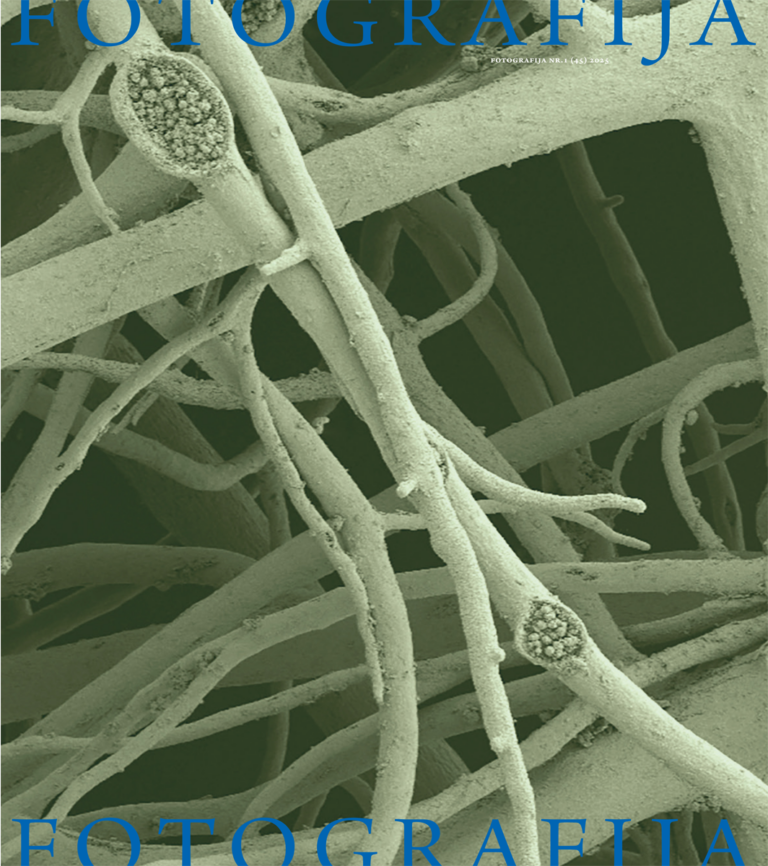
This issue of the journal is dedicated to presenting work of women artists that articulates fragile states and forms of coexistence through expanded photography. In their practices, planetary thinking manifests through ways of cultivating embodied relationships with the environment, microorganisms, and geological processes. In a sense, these are attempts to bring us closer to a material, intimate understanding of our environment. In the work of Ieva Maslinskaitė, photography is treated as a sensorial medium where images transform into fragile ecosystemic formations. Kotryna Ūla Kiliulytė explores the possibilities of radical intimacy in the face of ecological polycrises, addressing symbiotic, parasitic, and nurturing relations with various lifeforms. The work of Ieva Kotryna Ski employs photography, AI processes, and video to create dreamlike, unstable geological surfaces where rocks become fluid and the ground slips away beneath one’s feet. Here, the variation and instability of geological matter intertwine with the (im)materiality of the digital image, which would not exist without the specific geological resources required to create digital technologies. According to Kathryn Yusoff, based on the stratification of layers, geology has established what we consider human and non-human matter. Perhaps Ski’s approach to geological matter, as inseparable from culture, environment, and technologies, also invites us to question the presumed stability of categories.
Alongside the artists’ projects – “voiced” by their own reflections on the creative processes – theoretical insights from guest authors are interwoven. Žilvinė Gaižutytė-Filipavičienė, in her text Depicting the Undepictable, reviews the field of Anthropocene art in Lithuania and the issues of Anthropocene aesthetics, reflecting on the ambiguity of art when the alienation between culture and the natural world is actualised, turning all that is non-human into an object of artistic creation. Agnė Narušytė discusses the rising tensions between deep planetary time and the human perception of time, which, in Geistė Marija Kinčinaitytė’s projects aimed at questioning economic development plans on the Moon, intertwine with the melting glaciers of Iceland and the folds of lava fields. Skaidra Trilupaitytė, in her essay How to Predict “Terrifying Weather” (or Deadly Nature Metaphors), reflects on documentaries that represent encounters with natural forces through personal memories and amateur footage. She examines how the abundance of everyday information, which fragments and homogenises all tragedies, distances humanity from perceiving cataclysms on a global scale, even as meteorological forecasts incessantly warn of impending danger. Paulius Petraitis analyses how artists Ieva Maslinskaitė and Kristina Õllek enact a certain photographic counter-practice where images, affected by biological and geological processes, are treated as living ecosystems that challenge the established perception of photography as a technology intended to fix an image.
The technology of photography, inseparable from the observation and objectification of the environment and dependence on geological resources, is re-examined in the work of the artists presented in this issue as a tool, medium, or system to open up and sense a different, ethical, material, and intimate relationship with the Earth.
##