(U n) fi xing
Photography was born from a paradox: a desire to make permanent what is most impermanent. It is a technology conceived out of a scientific and cultural desire to arrest time itself: the fleeting reflection, the transient play of light, the momentary alignment of forms in the world. This foundational quest for fixity was inscribed into the medium’s public identity from its inception. In 1839, one of photography’s founders William Henry Fox Talbot enthused: “The most transitory of things, a shadow… may be fixed forever”.1 The same year, the statesman François Arago introduced the new apparatus not as an art form but as a scientific instrument, a peer to the thermometer and the barometer. This framing was profound. It conditioned the public to believe that the camera was an objective tool of inscription, that it “does not interpret. It records.”2 The photograph became a transparent window; to see what it was of, one had to suppress the consciousness of what it shows.
Perhaps no early thinker articulated this view with more startling clarity than Oliver Wendell Holmes. In 1859, he celebrated photography’s ability to perform a kind of metaphysical surgery on the world. He triumphantly proclaimed that “form is henceforth divorced from matter”, adding, “give us a few negatives of a thing worth seeing, taken from different points of view, and that is all we want of it.”3 This notable dismissal of the original object’s physical substance in favour of the stable, portable “form” helped establish a foundational ideology for the medium – one that privileged the reproducible copy over the messy reality from which it was taken.
And yet, this dominant narrative of fixity is not the only one to be told. Theorist Michelle Henning recently suggested that while the history of photography is traditionally told as a story of fixing the image, it could instead be understood as a history of letting loose or liberating the image.4 This potential for instability was always written into the technology. For us to believe in the photograph as a perfect trace of reality, we had to look away from the messy process of its creation and focus only on the final, seemingly stable print. But the chemical “fix” was never a total, final act, it was simply the halting of an ongoing chemical process. Henning’s point is that the image has never been as stable as its framing suggests – its fixity is an ideological after-effect. This inherent potential for rupture, built into the technology from the start, is exactly what today’s process-based photographic artists seize on. They aren’t just breaking a static object but performing a more profound operation: taking an image that was never fully fixed and deliberately re-grounding it, entangling it once more in a living, unpredictable material world.
In the contemporary imagination, the “unfixed” image is perhaps most commonly associated with the networked realm. Images now flow through our lives on screens, part of a vast stream defined by circulation and designed for quick consumption, or even disappearance. Social media platforms have made the fleeting photograph a part of daily communication, an image meant to be seen for a moment before it is forgotten or vanishes. The art world has, in turn, explored this new condition, often by using the ephemeral platforms themselves as site-specific venues. Kristina Õllek and Kert Viiart’s collaborative project “@exhibit_onscroll” (2017) used the Instagram grid itself as a site-specific exhibition format to question how the platform influences artistic practice and viewing habits. It was in this same spirit that the 2015 exhibition “This is It/Now”, which I co-curated with Max Marshall, took place entirely on Snapchat, a platform where images, by design, were available for only 24 hours. This mode of digital unfixing is therefore not about material decay but about controlled and temporary access – an instability written directly into the system’s code.
While this digital ephemerality undoubtedly challenges the permanence paradigm, a curious exploration is taking place away from the screen, as practitioners are increasingly taking an interest in the unfixity and materiality of the photographic image. Two examples are the Lithuanian artist Ieva Maslinskaitė and Estonian artist Kristina Õllek. Their work grounds the idea of “unfixing” in tangible, biological, and geological processes, shifting the focus from the immaterial network to
the living form. It is a deliberate return to matter. As the curatorial text for Maslinskaitė’s recent exhibition “to inhabit dryness” observes, we live in a world where “images flow, exchange, they seem weightless”, yet this illusion is constantly punctured by the messy precarity of the physical world: “oh but wait – there’s a tear in the roof and it’s raining”. It is this tangible, leaky materiality that the artists insist upon. They offer an opportunity to encounter the photograph not just as an image but as a physical object with tactility and material presence. This act is not simply about un-fixing the photographic image; it is about re-infusing it with the agency of the physical world, allowing the matter that Holmes so readily dismissed to breathe again.
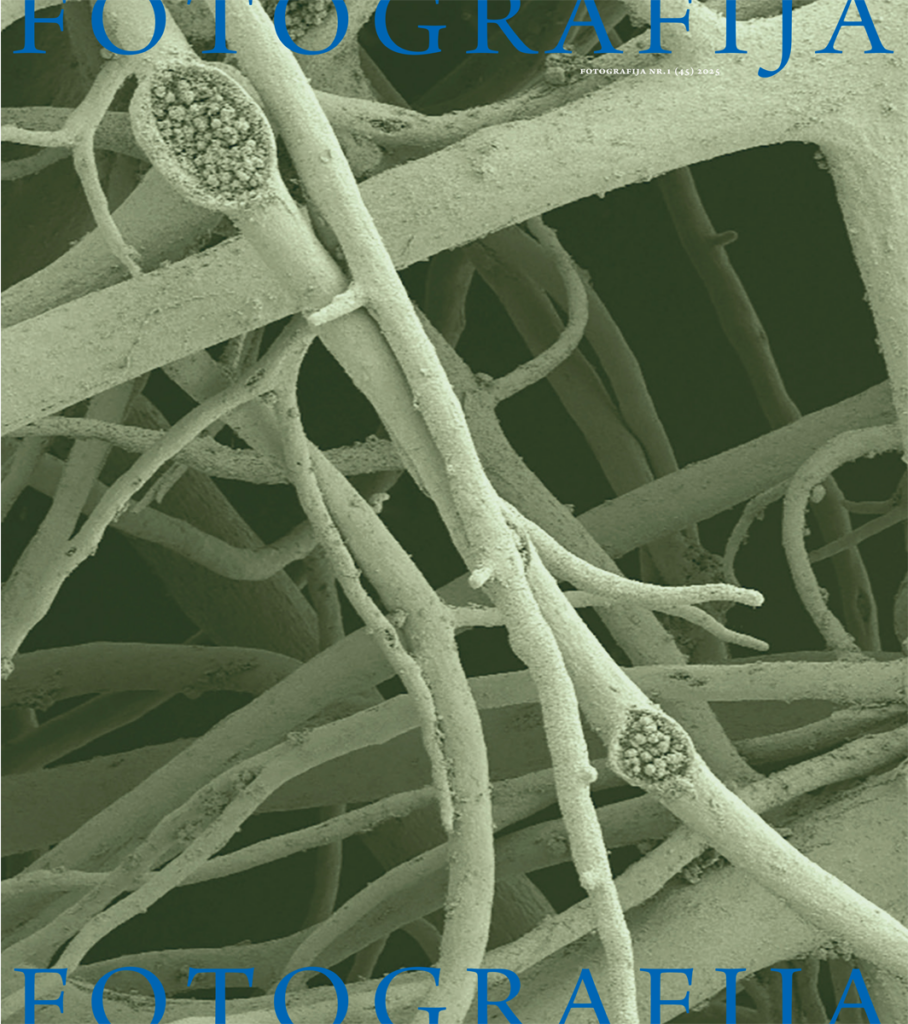
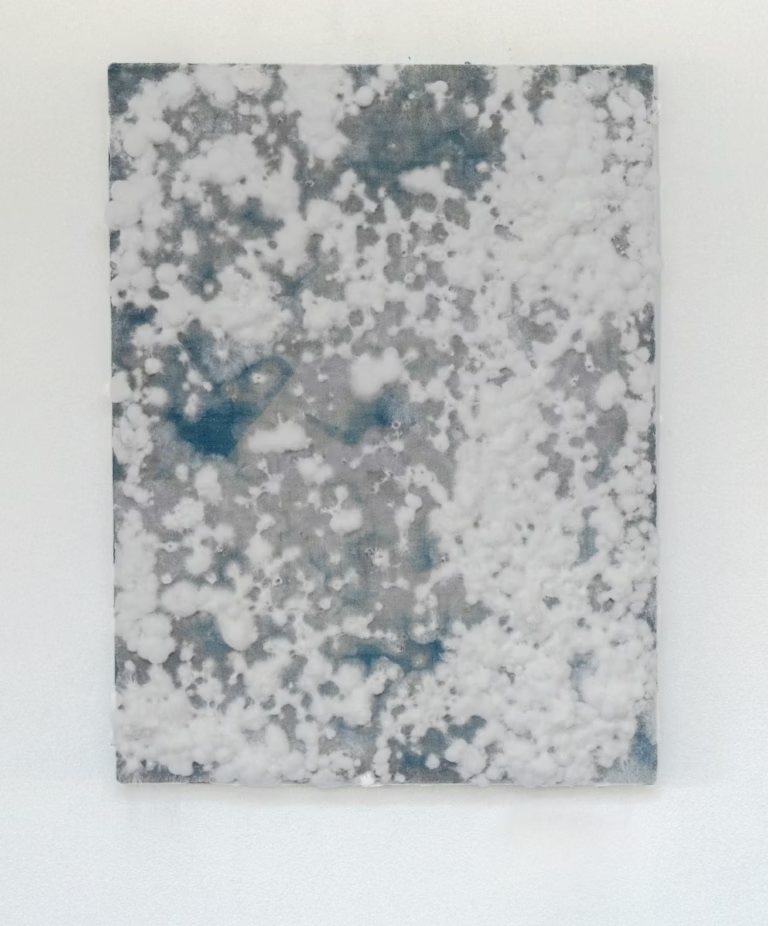
For Maslinskaitė, a photograph is not just an object but a habitat – a site where biological processes are invited to dismantle the image and, with it, the artist’s own anthropocentric control. This logic of consumption finds its clearest expression in “to inhabit dryness”, which staged a fundamental conflict. Here, living mycelium were placed onto cyanotype prints, creating an irreconcilable opposition: the print requires the very sunlight and dryness that would destroy the fungus, while the fungus thrives in a darkness and dampness that would ruin the print. It’s this intentional vulnerability that ensures the artwork can never be static. The artist’s role shifts from creator to collaborator, a process she terms “co-creating with other species”. And it’s no accident that the original photographs are themselves mundane phone images of “fragility and affect” – like a cracked eggshell or rain in a demolished house – as the image content foreshadows the object’s own material fate. As the mycelium consumes the print, the image gives way to an entirely new form. Eventually, the artwork dries into a porous skin, the final relic of a collaboration between artist and organism.
Where Maslinskaitė’s work operates through biological decay, Õllek creates hybrid forms through geological accretion. Her method explores unfixing not through subtraction but mutation, using water drawn directly from the Baltic Sea, one of the most polluted marine environments in the world. In a key process, she allows this water, laden with the chemical signatures of agricultural runoff and industrial waste, to evaporate, growing sea salt crystals directly onto her photographs and frames. This act adds a physical, evolving layer to the print, transforming the photograph, often depicting a coastal landscape, into a substrate for a new and unsettling geological reality. She combines these salt-encrusted images with other materials like cyanobacteria – the very organism behind the sea’s toxic blooms – sand, and silicone, creating a hybrid object where the boundaries between fact and fiction, the organic and the artificial, productively blur. Õllek’s method is defined by a complex and often beautiful form of material contamination. She allows the messy matter of the Anthropocene, from the excess salinity to the toxic residue of hypoxic dead zones, to literally crystallise on and mutate the clean photographic form. The unfixing occurs as the image loses its status as a pure representation and becomes, instead, a direct material witness. The photograph is no longer just an image of the sea; it becomes an object that has been physically acted upon by the sea’s compromised chemistry, an evolving archive bearing the tangible evidence of a planetary crisis.
The journey of the photographic image, from chemically “fixed” record to mutable object, reflects an evolution in our relationship with representation. The 19th-century imperative of fixity, legitimised by scientific objectivity, sought to conquer the material world by abstracting it, leading to a culture that habitually sees through the photograph while ignoring its physical thingness. Yet this stability was always an illusion. The potential for unfixing was latent in the medium’s very chemistry – a process of becoming merely halted, not concluded. This inherent instability gains a new urgency in our contemporary cultural condition, a “post-truth” era saturated with digital images and grappling with a crisis of faith in the photographic document. It is here that the work of Maslinskaitė and Õllek offers a crucial counter-practice: by inviting biological and geological forces to act on the image, they relinquish anthropocentric control to reveal our deep entanglement with the material world. Their work suggests that a critical photographic practice today lies not (only) in producing more perfect records of a world in crisis, but in creating fragile objects that bear the material traces of that very precarity. Maslinskaitė’s decaying images and Õllek’s crystallising artifacts are not just pictures of ecology; they are fragile ecologies in themselves, intimating that the most resonant image for our time is one that is vulnerable, mutable, and alive.
1 William Henry Fox Talbot, “Some account of the art of photogenic drawing, or, the process by which natural objects may be made to delineate themselves without the aid of the artist’s pencil’, in Photography in Print, ed. Vicki Goldberg (Albuquerque: NM, 1981), p. 40.
2 From the Encyclopédie française, as cited in Brian Winston, “The Documentary Film as Scientific Inscription”, in Theorizing Documentary, ed. Michael Renov (New York: Routledge, 1993), p. 41.
3 Oliver Wendell Holmes, “The Stereoscope and the Stereograph”, in Classic Essays on Photography, ed. Alan Trachtenberg (New
Haven: Leete’s Island Books, 1980), p. 80.
4 Michelle Henning, Photography: The Unfettered Image (London: Routledge, 2018).