My borders are nocturnal
My borders are nocturnal. They’re the shadows of the street turned to sleep. There I find pleasure
in smudging outlines: orange-purple, amber light spills, meeting the tips of my feet. I brush out the braids of the unknown, and her waves crash into me. It cloaks my shadow and entangles it in honesty.
I think about images. For a long time they were too penetrable. Glossy, smooth, irresistible in their form. Inside there is a world, but at the edges they cut – causing an unsettling anxiety in me. The seemingly clear formula of light, time and sensitivity in photography troubles me. I think about its relationality and aliveness, and I cannot force it into a frame. I think about structure and I want it to collapse. A frame shattered to pieces that allow for a rounding of sorts. I go for a walk, I want to clear my head – I stroll along the edges of the image.
With every step, I rub against borders. With discontent, I tread and erode materials that hold the shape of an image. The image is now loose. The image is becoming and disappearing at the same time. The image is elusive. The image is a shadow, a spilling. The image has a carrier, but the relationship is conditional. It reflects, projects, seeps into fibres or lights up. It emerges and brightens as much as it fades, leaks, rubs or cracks. Their relationship is complicated; it is an ecosystem of material doubt. It is less of a promise and more of a dance. The image is endlessly dancing with its carrier as I am dancing with my shadow. And when I walk at night, our boundaries are more blurred.
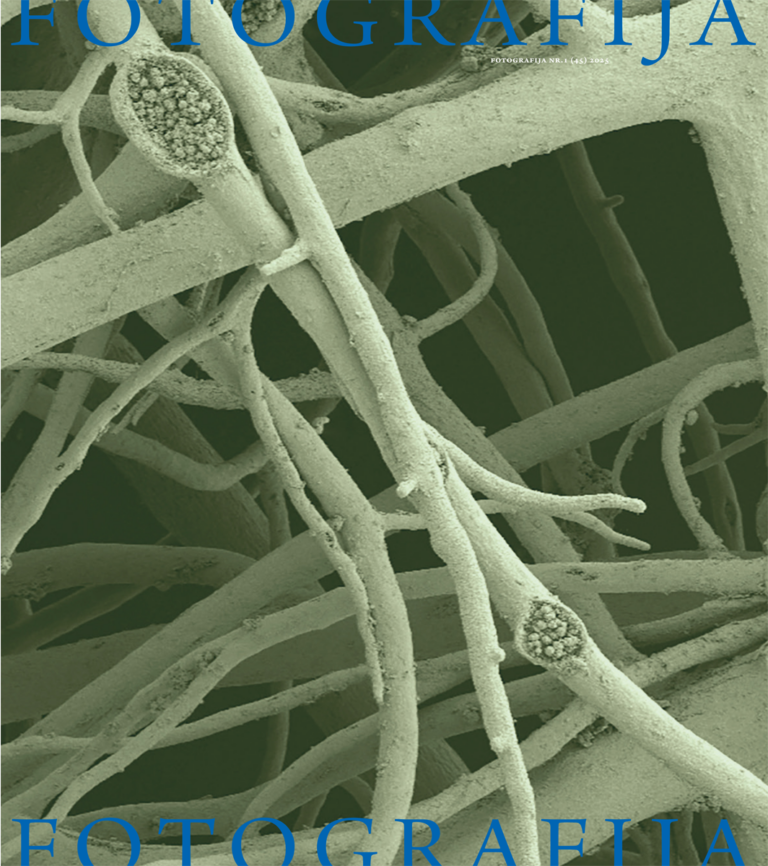
to inhabit dryness is an exercise in tracing the shadow with the uncertainty of the night. Like a shadow, the image migrates in-between space, surface, memory and sense. Images fade and transform as they are overtaken by mycelium networks. Instead they inhabit wall surfaces, or they leave ghosts. They might inhabit nostrils. The shapeshifting is discreet. It appears only at points of witness. Requiring wetness to sustain its changes it reflects on the uncertain and perhaps futile process of crawling out of water to inhabit dryness.
The images that I practice, they grow. They spread. They react and counteract. They contaminate. They drip; they make sounds. They’re thirsty. They smell. They die. I check on them daily as if they were house plants. I feel anxious that something is off. I feel possessive, I want control. I feel at ease, I trust. The ecology of image-making in my practice spreads beyond power dynamics of subject and (human) maker and expands into the realm of feelings and care that are grounded in material relations and agency of the (more-than-human) other. Photography for me embraces sensory and not just representational logics. I practice its alive material relations and sensitivities to look for new beginnings, tools and vocabularies to think about images, to disrupt binary thinking and blur boundaries around self, other and environment. What emerges is an entanglement of multi-species and material affect, the image as a spider-web, reflecting dew drops, shaking from the wind and leaving sticky residue on my skin when I pass through.
The web of the image is entangled with processes and materials and that make the image fragile. I think about the fragilities of the everyday. Leaky pockets, worn down shoes, broken bones, cracked cobblestones. When you peak through the fingers of your covered face. Damp with fear, fragility offers me hope at the same time. Fragility offers me the potential for transformation, the potential for growth. And in this way, it makes me hopeful to think that even the most rigid and oppressive structures have cracks or fractures. That they too are porous to be affected and transformed. As you turn the page, I hope you feel it tear.